In brief
- Surgery is not the first step for every child who walks on their toes. It is considered when symptoms or a fixed calf–Achilles contracture persist and appropriate non-surgical treatment has failed or is unsuitable.
- A 2026 study of 38 surgically treated children found better ankle motion, gait parameters, pain and satisfaction at a mean 1.3-year follow-up, but the sample was small and follow-up was too short to define long-term recurrence.
- In a separate retrospective cohort of 106 children, recurrent toe walking after surgery was more frequent in children with autism spectrum disorder or a similar sensory processing disorder than in idiopathic toe walkers.
- Toe walking alone does not diagnose autism or a neurological disorder. If neurodevelopment has never been assessed and developmental, behavioural, sensory or neurological concerns are present, a targeted paediatric neurodevelopmental assessment should be considered.
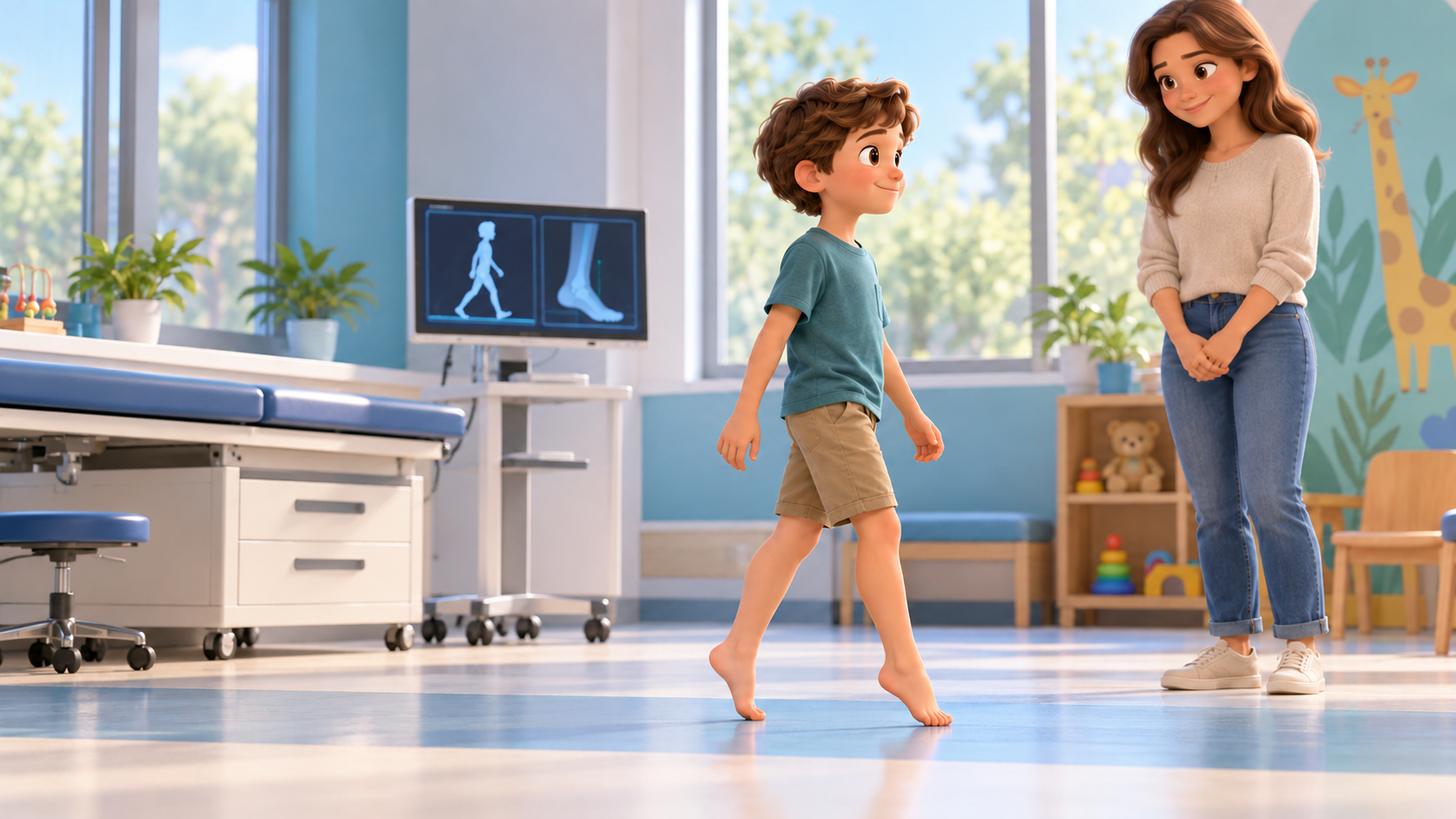
Toe walking is common in early childhood. In many children it is flexible and intermittent: they can place their heels down when asked and ankle motion remains preserved. Surgery is not indicated simply because the gait looks unusual.
The question changes when the child cannot reach a plantigrade position, the calf–Achilles complex has become shortened, pain or functional limitations are present, or a structured non-surgical pathway has not achieved the agreed goals.
Before discussing surgery: is it truly idiopathic?
“Idiopathic toe walking” is a diagnosis of exclusion. Assessment should include the onset and evolution of the gait, developmental history, symmetry, muscle tone and strength, reflexes, ankle dorsiflexion with the knee flexed and extended, and the child’s ability to voluntarily achieve heel contact.
Late onset after a period of normal heel-to-toe walking, regression, asymmetry, weakness, spasticity, abnormal reflexes, frequent falls or loss of previously acquired abilities should not be labelled as an idiopathic habit without further assessment.
Autism spectrum disorder, ADHD and sensory processing differences may coexist with toe walking. Their presence does not automatically explain the gait and does not exclude orthopaedic treatment. Conversely, toe walking by itself is not enough to suspect or diagnose autism.
If the child has never had a neurodevelopmental assessment and there are concerns involving language, social interaction, behaviour, sensory processing, motor milestones or regression, it is reasonable to involve the paediatrician and, when appropriate, child neuropsychiatry or paediatric neurology. Referral should be guided by the overall clinical picture, not by toe walking alone.
In the 2018 Haynes study, 62% of children had a neurological or neurodevelopmental diagnosis, but this figure came from a highly selected group already referred by paediatric orthopaedic surgeons to a tertiary neurology clinic. It must not be interpreted as the prevalence among all children who toe walk. The useful message is the pattern of warning features: concerning birth history, delayed independent walking, unilateral or asymmetric toe walking, upper- or lower-motor-neuron signs, regression or relevant behavioural/developmental concerns.
When is surgery considered?
The 2024 BSCOS/APCP consensus recommends non-surgical treatment first. Referral for surgical consideration is appropriate when primary treatment has failed or is unsuitable. The decision is not based on a single degree measurement.
Elements usually considered together include:
- a fixed contracture that prevents plantigrade dorsiflexion;
- pain, fatigue, difficulty with footwear or functional limitation;
- meaningful psychosocial impact;
- progression despite observation, stretching, physiotherapy, orthoses or serial casting, when indicated;
- age, skeletal maturity and the child’s overall diagnosis;
- goals shared with the child and family.
The procedure is selected from the clinical pattern. An isolated gastrocnemius tightness is different from a combined gastrocnemius–soleus or Achilles contracture. Gastrocnemius recession, open lengthening or percutaneous techniques are not interchangeable labels and should be chosen by the operating surgeon after examination.
What the new 2026 surgical study found
Bowsie and colleagues studied 38 patients treated for an idiopathic toe-walking pattern with calf contracture who underwent bilateral calf lengthening. The study allowed inclusion of children with an autism diagnosis, but the PubMed abstract does not report separate subgroup outcomes. Mean age at surgery was 10.3 years and mean follow-up was 1.3 years.
Thirty-four patients had complete kinematic data and 30 had complete kinetic data. After surgery, ankle dorsiflexion improved. Walking speed increased through longer step length, while cadence decreased. The Gait Profile Score improved from 11.4° away from normal before surgery to 6.2° afterwards. Ankle push-off power and work in late stance also increased. Pain decreased and satisfaction was high.
No recurrence or overcorrection was observed in that short follow-up. This is encouraging, but it does not establish durable long-term results: the cohort was small, there was no non-operative control group and mean follow-up was only about 16 months.
Autism, sensory differences and recurrence
A different 2026 single-centre retrospective study reviewed 106 surgically treated children over 12 years. Twenty-nine had autism spectrum disorder or a similar sensory processing disorder; 77 were classified as idiopathic toe walkers.
Recurrence occurred in 24% of the neurodiverse/sensory-processing group and 5% of the idiopathic group. In the adjusted analysis, an underlying sensory processing disorder remained associated with recurrence, with an odds ratio of 7.5. The confidence interval was wide (1.5 to 45.2), reflecting limited precision.
This finding should not be used to deny treatment to neurodiverse children. The BSCOS consensus explicitly states that they should be offered treatment, with appropriate counselling about recurrence. It does mean that goals, sensory tolerance, rehabilitation, family expectations and follow-up deserve particular attention.
It also helps reconcile the two 2026 studies: no recurrence at approximately one year does not contradict recurrence emerging at a mean 2.6 years in another cohort. Duration of follow-up matters.
What surgery can and cannot promise
Lengthening can restore ankle range and improve gait mechanics when a true contracture is present. It cannot guarantee that every child will permanently adopt a heel-to-toe gait, particularly when sensory or neurodevelopmental factors contribute to the walking pattern.
The goal is not necessarily to make every step look identical to a population average. It is to address the child’s specific problem: contracture, pain, function, footwear, fatigue or participation.
For this reason, the pathway should remain multidisciplinary when needed. Orthopaedics assesses the mechanical component; physiotherapy supports mobility, strength and gait; paediatric or neurodevelopmental specialists help clarify developmental and neurological features when the history or examination indicates it.
Follow-up after surgery
The BSCOS consensus recommends at least 12 months of follow-up after surgery and documentation of outcomes. The recurrence study suggests that longer observation may be useful, especially when autism or sensory processing differences coexist.
A renewed tendency to toe walk does not automatically mean that the operation “failed.” It requires reassessment of ankle range, symptoms, function and the factors contributing to the gait before deciding whether further treatment is appropriate.
Take-home message
Surgery is considered for selected children with persistent symptoms or a fixed contracture after an appropriate non-surgical pathway, not for toe walking alone.
Autism and sensory processing differences do not exclude treatment, but available data suggest a higher risk of recurrence. If neurodevelopment has never been assessed and there are relevant developmental or neurological concerns, completing that assessment is part of good care. It is not a test requested automatically for every child who walks on their toes.
References
- Bowsie K, Molloy M, McDowell BC, Cosgrove A. Surgical treatment for idiopathic toe walkers gives good biomechanical and patient satisfaction outcomes. Gait Posture. Published online October 6, 2026. doi:10.1016/j.gaitpost.2026.110662. PMID: 42854642. PubMed
- Zak TK, Minopoli A, Polk JL, et al. Recurrent toe walking in pediatric orthopedic patients: idiopathic versus concomitant sensory processing disorders. J Pediatr Orthop B. 2026;35(5):452-456. doi:10.1097/BPB.0000000000001361. PMID: 42244456. PubMed
- Gelfer Y, McNee AE, Harris JD, et al. The management of idiopathic toe walking. Bone Joint J. 2024;106-B(10):1190-1196. doi:10.1302/0301-620X.106B10.BJJ-2024-0466.R1. PMID: 39348908. PubMed
- Haynes KB, Wimberly RL, VanPelt JM, et al. Toe Walking: A Neurological Perspective After Referral From Pediatric Orthopaedic Surgeons. J Pediatr Orthop. 2018;38(3):152-156. doi:10.1097/BPO.0000000000001115. PMID: 29309384. PubMed
Related pages:
Italian versions:
Disclaimer: This content is for general information and does not replace an individual clinical or neurodevelopmental assessment.