Flatfoot in Children: When to Worry
Flat feet in young children are usually a normal developmental variant. Assessment criteria and when orthotics may help.
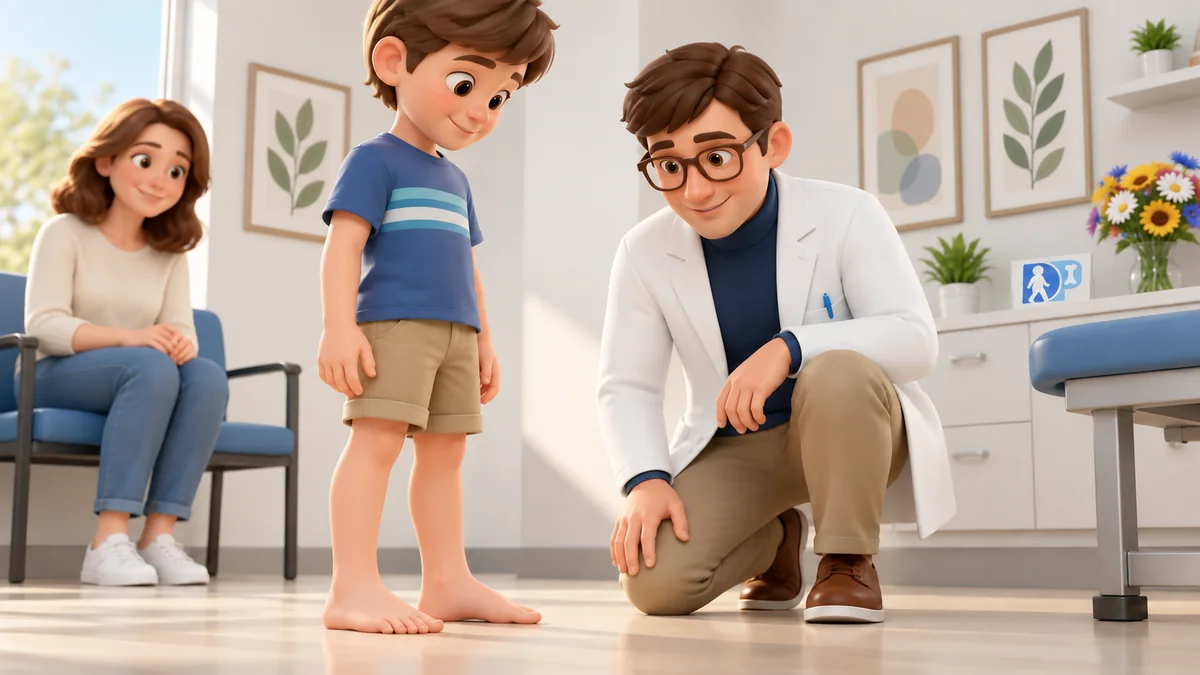
There is more to assess than the arch
A low arch can be a normal variation. The examination considers flexibility, pain and the child's activities alongside foot shape: appearance alone does not establish a need for treatment.
Read all the illustrated explanations →In most children flatfoot is a physiological feature of growth: the plantar arch develops gradually and usually defines itself during the first school years. It is one of the most common reasons for a pediatric orthopaedic consultation and, in the large majority of cases, requires neither orthotics nor treatment.
During the visit we distinguish the flexible flatfoot (by far the most common form), in which the arch reappears when the foot is unloaded or the great toe is lifted and which is usually painless, from the rigid flatfoot, less frequent but more significant, in which the flattening persists and may be associated with pain or limited movement — a picture that deserves further evaluation to rule out structural causes such as a tarsal coalition.
A specialist evaluation is appropriate when there is pain, stiffness, marked asymmetry between the two feet, worsening over time, limitation in daily or sports activities, or when the foot remains markedly flat at school age. The goal is not to "straighten" a normal foot, but to identify the situations that really benefit from a dedicated pathway and to reassure families in the others. Orthotics or surgery, when indicated, are decided on the individual child: never an automatic choice, never a universal treatment.
Flatfoot often accompanies hindfoot valgus (the lower part of the heel tilts outward when viewed from behind): a related but distinct finding. Learn about hindfoot valgus →

👣Dr. Priano's Advice
Flexible flatfoot is very common in childhood and often needs no treatment when it is mobile and asymptomatic. Pain, stiffness, asymmetry or activity limitation change the significance of the finding and are useful reasons for assessment.
Assessment and treatment
When to seek evaluation
- Flatfoot persisting with growth, associated with pain, stiffness or limitation
- Pain during walking or physical activity
- Hindfoot rigidity
- Arch absent even when non-weight-bearing (rigid form)
- Marked asymmetry between the two feet
- Early fatigue during walking
What is evaluated
- Clinical evaluation of plantar arch in weight-bearing and non-weight-bearing
- Jack's test (hallux dorsiflexion)
- Hindfoot and subtalar mobility
- Gait and posture examination
- Possible weight-bearing radiographic study
Treatment options
- Observation and periodic follow-up in physiological cases
- Custom orthotics in selected cases
- Physical therapy for muscle strengthening
- Minimally invasive surgical treatment (arthroereisis) in selected symptomatic cases
When Surgery Is Needed
Read about flatfoot surgery in children.
Types of Flatfoot
Flexible Flatfoot
This is the most common form. The arch is low during weight-bearing but reforms off-load or when the clinician lifts the big toe. The hindfoot is mobile. In early childhood it may be a physiological variant; arch development varies, without a fixed age by which correction must occur.
Treatment: Painless flexible flatfoot generally needs no treatment, specific exercises or physiotherapy. In selected symptomatic cases, treatment may address muscle tightness, weakness or functional difficulties; orthoses may improve comfort. Surgery is considered only after individual assessment of persistent symptoms and limitations despite appropriate conservative care.
Rigid Flatfoot
The arch remains flat off-load and hindfoot movement is restricted. Pain may be present. Achilles tendon tightness alone is not equivalent to structural foot rigidity; they require separate assessment.
- Bony, cartilaginous or fibrous tarsal coalitions, such as calcaneonavicular or talocalcaneal coalitions
- Congenital vertical talus
- Neuromuscular conditions
Treatment: Always requires thorough specialist evaluation. Treatment depends on the cause: may be conservative or surgical.
Frequently Asked Questions
At what age does flatfoot correct itself?▼
Are orthotics needed for flatfoot?▼
When to operate on flatfoot?▼
Is flatfoot hereditary?▼
How can I tell flexible from rigid flatfoot?▼
My child wears down the inner edge of shoes: should I worry?▼
Are orthopaedic shoes needed for flatfoot?▼
Important Notice: The information on this page is for educational and informational purposes only and does not constitute medical advice. Each clinical case is unique: the appropriate treatment is determined during the specialist consultation, based on a thorough clinical examination and, where necessary, diagnostic imaging. For any doubts or concerns, please consult a specialist.