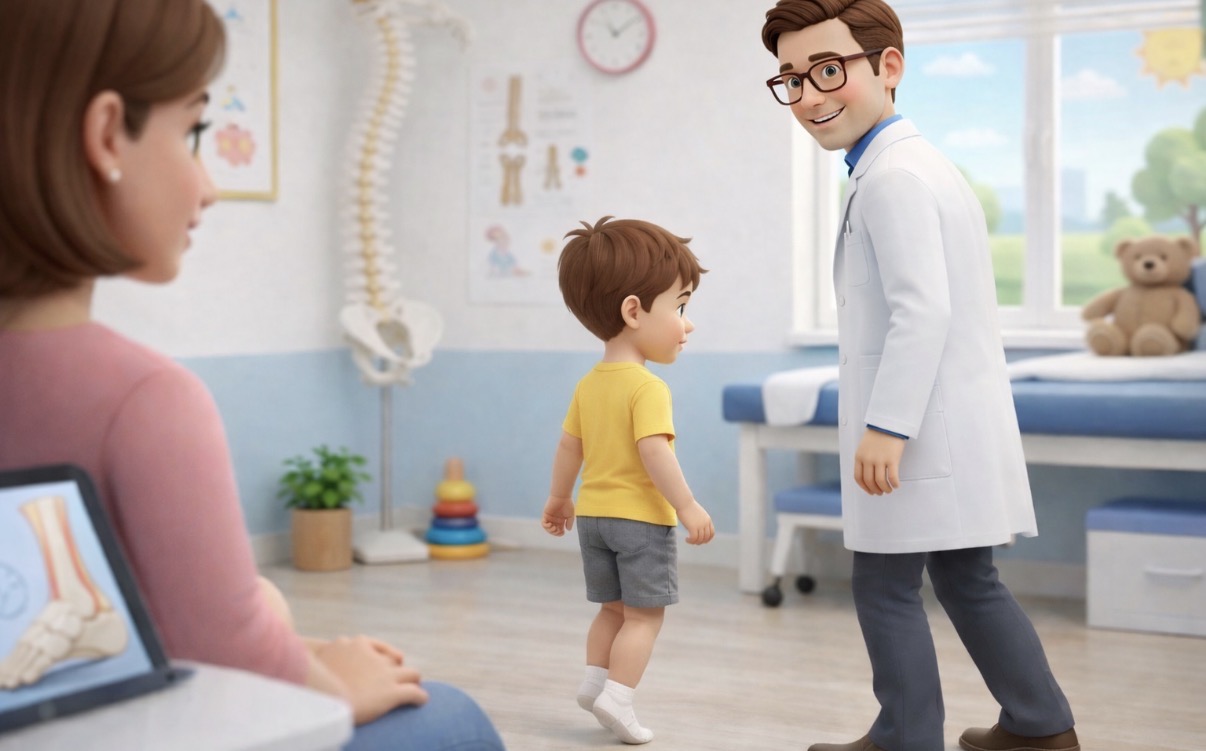
Toe walking is common in the early stages of development, especially shortly after a child learns to walk. When it persists, appears later, or is associated with other signs, the evaluation changes.
When to investigate further
A 2025 review proposes three simple red flags: toe walking that persists for more than 6 months after independent walking is acquired, persistence beyond 2 years of age, or the appearance of tiptoeing in a child who previously walked normally. [1]
These criteria do not automatically indicate a neurological or orthopedic condition. However, they do identify children for whom simple observation without re-evaluation is less appropriate.
When can we speak of idiopathic toe walking
Idiopathic toe walking is a diagnosis of exclusion. The medical history and physical examination must consider motor development, any regression, tone and strength, symmetry, ankle range of motion, and neurological signs. [1][2]
The walking pattern also helps. Some children have preserved dorsiflexion and toe walk intermittently; others develop tightness of the gastrocnemius–soleus muscles or Achilles tendon that genuinely limits dorsiflexion. These are different situations and do not require the same approach. [2][3]
What we know about conservative treatments
The quality of evidence remains modest.
A randomized trial published in 2025 compared serial casting, exercises, and observation in 29 children aged 3 to 10 years with idiopathic toe walking. Casting and exercises achieved overall similar results on dorsiflexion and the severity of toe walking. Both showed improvements over time and, compared to the observation group, some advantages in functional outcomes and walking severity. [3]
The sample size is small and does not allow for establishing a rigid hierarchy between the two strategies. The presence of tightness, age, and functional impact remain important factors in the choice.
Observation and natural history
Data on natural history are less robust than one might think. A classic study by Eastwood and colleagues showed that many children improve over time, but not all spontaneously normalize their gait; isolated casting did not seem to significantly alter the natural history. [4]
This explains why observation may be reasonable in a child without red flags, with good ankle mobility and a typical presentation, while persistent toe walking associated with tightness or atypical features warrants more active management.
What changes during follow-up
During follow-up, I primarily observe whether the child can place their heel down when asked, whether dorsiflexion remains preserved, whether the presentation is symmetrical, and whether pain, stiffness, regression, or other neurological signs appear.
Treatment should not automatically begin solely due to the presence of toe walking. First, it must be clarified whether we are truly dealing with an idiopathic form and whether there is a mechanical problem to correct.
Disclaimer
This content is for informational purposes only and does not replace an individual clinical evaluation.
References
[1] Baldo F, Traunero A, Ballaben A, Zago A, Barbi E. Red Flags in the Evaluation of the Tiptoeing Child. J Paediatr Child Health. 2025;61(4):540-544. doi:10.1111/jpc.16793. PMID: 39923242.
PubMed: https://pubmed.ncbi.nlm.nih.gov/39923242/
[2] Gelfer Y, McNee AE, Harris JD, et al. The management of idiopathic toe walking. Bone Joint J. 2024;106-B(10):1190-1196. doi:10.1302/0301-620X.106B10.BJJ-2024-0466.R1. PMID: 39348908.
PubMed: https://pubmed.ncbi.nlm.nih.gov/39348908/
[3] Giray E, et al. A comparative randomized-controlled trial of serial casting and exercises on ankle range of motion, toe walking severity, walking balance, and functional health-related quality of life in children with idiopathic toe walking. J Pediatr Orthop B. 2025. PMID: 40167594.
PubMed: https://pubmed.ncbi.nlm.nih.gov/40167594/
[4] Eastwood DM, Menelaus MB, Dickens DRV, Broughton NS, Cole WG. Idiopathic toe-walking: does treatment alter the natural history? J Pediatr Orthop B. 2000;9(1):47-49. doi:10.1097/01202412-200001000-00010. PMID: 10647110.