Toe Walking: When to Worry
Occasional toe walking can occur during early walking. Persistence, asymmetry, new onset, contracture or motor difficulties warrant assessment.
Quick Answers
Is toe walking always pathological?
Are special shoes needed for toe walking?
Understanding the problem
Toe walking may occur during early walking. Persistent or frequent toe walking beyond the early years, a one-sided pattern or onset after previously normal walking should be discussed with the paediatrician. Weakness or loss of acquired skills requires prompt assessment.
Idiopathic toe walking is a diagnosis of exclusion: bilateral toe walking began with walking and is not explained by an identified neurological condition. Calf contracture may or may not be present; being able to place the heels down does not establish the diagnosis. Autism or ADHD can coexist and do not alone establish a neurological cause of the gait pattern.
At assessment I consider developmental history, strength, ankle mobility, walking and neurological findings. Management depends on pain, contracture, function and impact on the child: treatment is not automatic when symptoms and contracture are absent. Stretching, exercises, orthoses or other options are selected after assessment, without promising the same response in every child.
Toe walking: when to seek advice
Video · 57 seconds · English audio and subtitles
Illustrated video with a synthetic voice. Press Play to load the YouTube player. Open on YouTube
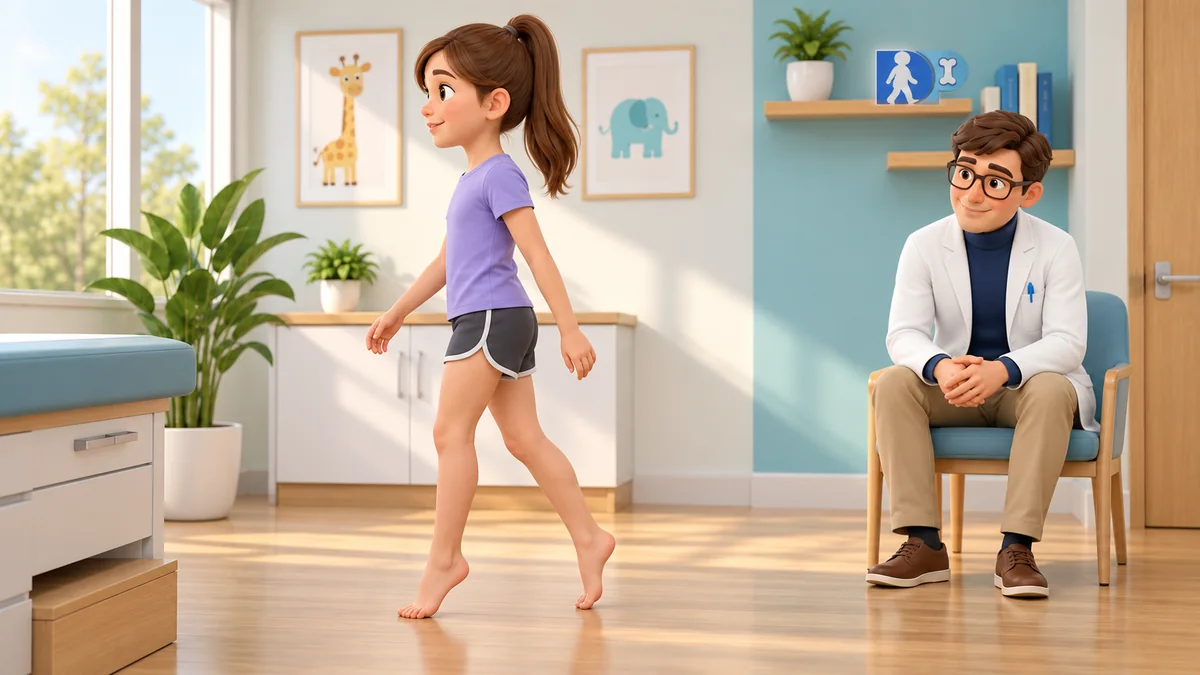
The heels stay raised
In toe walking, the child walks on the balls of the feet. Notice how often it happens and whether it affects both sides.
Read all the illustrated explanations →
🦶What I Observe During the Visit
Toe walking is common in toddlers learning to walk. It becomes important to evaluate when it persists beyond age 3 or when the child cannot place their heels flat on the ground. During the visit, I check Achilles tendon flexibility and rule out underlying neurological causes.
Assessment and treatment
When to seek evaluation
- Persistent toe walking beyond 3 years
- Inability to touch the ground with heels
- Achilles tendon retraction
- Asymmetry between the two feet
- Other associated neurological signs
What is evaluated
- Basic neurological examination
- Ankle dorsiflexion evaluation
- Gait pattern analysis
- Exclusion of secondary causes
- Possible neurological consultation
Treatment options
- Observation in young children with a symmetrical, flexible pattern and no significant neurological or functional concerns
- Stretching and rehabilitation when indicated, planned after assessing dorsiflexion, function and the child's goals
- Braces or orthoses in selected cases
- Serial casting when restricted dorsiflexion and the clinical picture justify progressive lengthening
- Neurological or neuro-orthopaedic assessment when the history or examination is not consistent with idiopathic toe walking
- Surgical lengthening of the gastrocnemius–soleus/Achilles complex in selected cases with an established contracture and a specialist indication
- Assessment of outcomes through function, comfort and walking pattern, not just the ability to place the heel down during the appointment
Frequently Asked Questions
Is toe walking always pathological?▼
Are special shoes needed for toe walking?▼
Can toe walking be a sign of autism?▼
My child only walks on tiptoes sometimes: should I worry?▼
Does stretching really work?▼
When is surgical Achilles tendon lengthening considered?▼
Important Notice: The information on this page is for educational and informational purposes only and does not constitute medical advice. Each clinical case is unique: the appropriate treatment is determined during the specialist consultation, based on a thorough clinical examination and, where necessary, diagnostic imaging. For any doubts or concerns, please consult a specialist.