Knock-knees and Bow legs: Crooked Legs in Children
Knock knees or bow legs are a normal part of growth at certain ages. What matters is age, symmetry, progression and residual growth.
Quick Answers
Is it normal for a child to have crooked legs?
When should I worry about knock-knees?
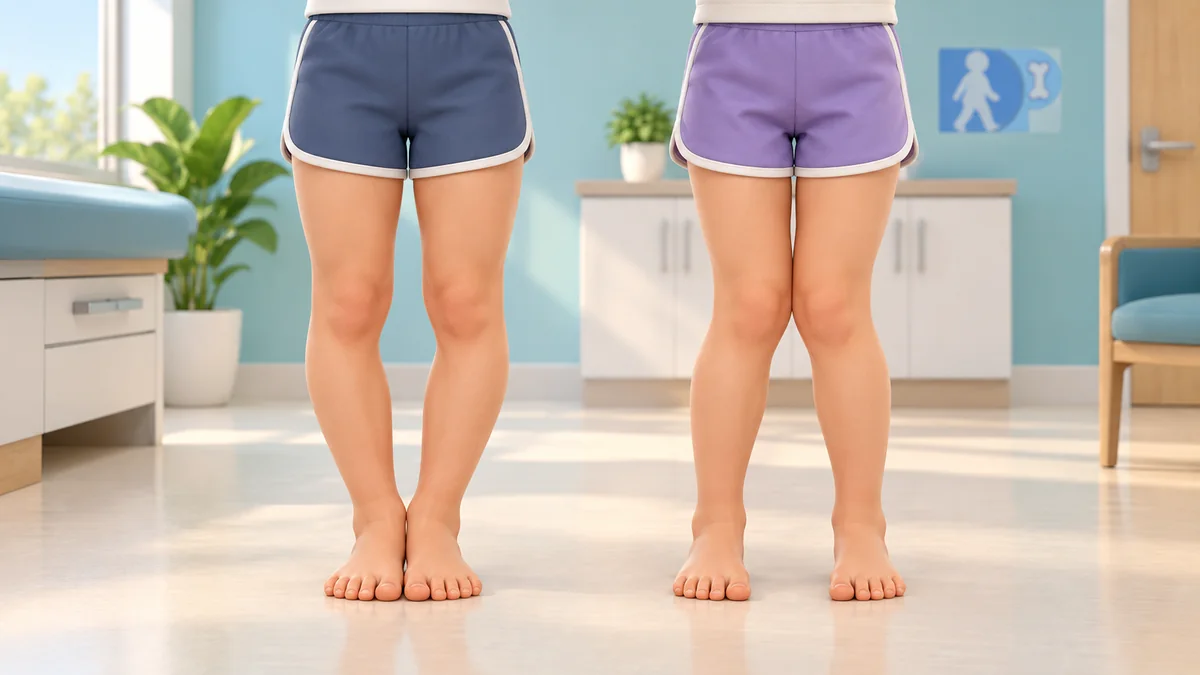
Two different shapes
Bow legs are shown on the left: the knees are apart with the ankles close together. Knock knees are on the right: the knees are close with the ankles apart. The illustration explains the difference; it cannot measure or diagnose a deformity.
Read all the illustrated explanations →Crooked legs — knock-knees (genu valgum) and bow legs (genu varum) — are part of the normal evolution of lower limb alignment during growth. In the first years of life a varus appearance typically prevails, gradually giving way to a valgus phase in preschool and school age, until final alignment is reached in later childhood.
In the great majority of cases this is a physiological, self-limiting picture that changes spontaneously with bone growth, without the need for corrective devices, insoles or braces. A markedly increased deviation, asymmetry between the two limbs or progressive worsening is, however, a signal that deserves a clinical evaluation.
During the visit we observe posture, gait and limb axis, ruling out secondary causes (nutritional deficiencies, bone disorders, post-traumatic changes) and agreeing with the family on an appropriate observation plan. The same deviation can be entirely physiological at one age and deserve further evaluation at another: what makes the difference is age, symmetry, how it evolves over time, the site of the deformity and the residual growth available.
This page answers the question "is it physiological in my child?". When the evaluation does confirm an indication for treatment, the useful window to exploit residual growth is not unlimited: for this reason, in doubtful or marked cases, it is best not to delay the evaluation. Only in selected situations, of marked degree or with significant evolutive potential, is a targeted correction considered, described on the dedicated surgical page.

🦵Children's Legs Change
Knock knees ('X-shaped') are physiological between ages 3-7, just as bow legs ('O-shaped') are normal in the first 2 years. These are developmental patterns that correct spontaneously in most cases. I evaluate if it's within normal range for age or requires further investigation.
Assessment and treatment
When to seek evaluation
- Varus that remains marked beyond 2-3 years or does not improve
- Marked valgus or valgus persisting beyond 8-10 years
- Significant asymmetry between the two legs
- Deviation progressively worsening with growth
- Pain or gait disturbances
What is evaluated
- Clinical evaluation of knee alignment, relative to age
- Comparison between the two limbs to detect asymmetries
- Mechanical axis evaluation of lower limbs
- Gait and posture examination
- Weight-bearing lower limb X-rays when indicated
- Exclusion of pathological forms (rickets, dysplasias)
Treatment options
- Observation and follow-up in most cases
- Periodic photographic and clinical monitoring
- Guided temporary hemiepiphysiodesis (growth modulation) in selected cases
- Corrective osteotomy in severe forms
Types and Normal Values
🦵Genu Varum (Bow Legs)
The knees are apart while the ankles touch. This is a physiological pattern in the first 1-2 years of life, which tends to progressively reduce. What matters clinically is not an isolated measurement taken at home, but the child's age, the symmetry between the two sides and how it evolves over time: a varus that is marked, asymmetric or does not reduce with growth deserves an evaluation.
Normal Evolution:
🦵Genu Valgum (Knock Knees)
The knees touch while the ankles are apart. This is a physiological pattern between roughly 3 and 6-7 years. Here too, no measurement taken at home can on its own establish whether the picture is normal: what counts is age, symmetry, evolution over time, the site of the deformity and residual growth.
Normal Evolution:
Frequently Asked Questions
Is it normal for a child to have crooked legs?▼
When should I worry about knock-knees?▼
Do braces or special shoes correct crooked legs?▼
Are crooked legs hereditary?▼
My child plays sports: are knock-knees or bow legs a problem?▼
Is there an age by which crooked legs must be corrected?▼
Can the pubertal growth spurt worsen knock-knees?▼
What is a weight-bearing lower limb X-ray for?▼
What's the difference between hemiepiphysiodesis and adult corrective surgery?▼
How long is follow-up after a diagnosis of genu valgum or varum?▼
Important Notice: The information on this page is for educational and informational purposes only and does not constitute medical advice. Each clinical case is unique: the appropriate treatment is determined during the specialist consultation, based on a thorough clinical examination and, where necessary, diagnostic imaging. For any doubts or concerns, please consult a specialist.