Kyphosis and Round Back: When to Worry
A hunched back in adolescence: the difference between postural kyphosis and Scheuermann's disease, and when bracing is indicated.
Quick Answers
What is the difference between postural kyphosis and Scheuermann's disease?
Does the school backpack cause kyphosis?
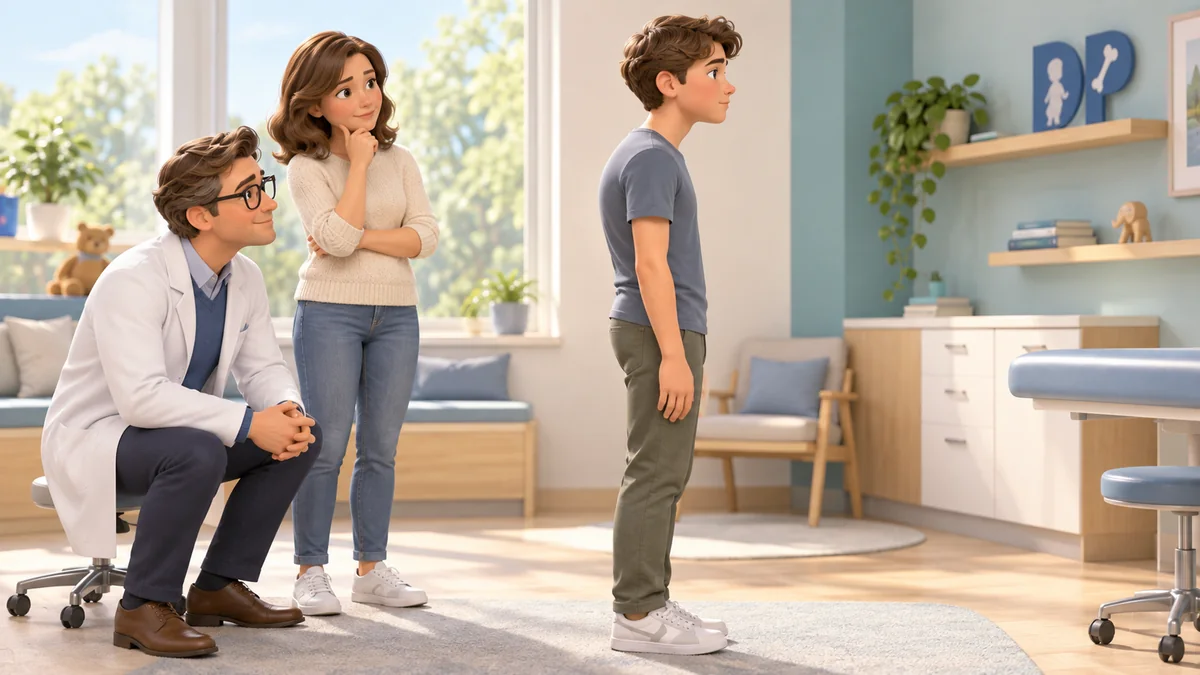
A profile is not enough
A rounded back may be flexible or related to vertebral changes. Appearance alone cannot distinguish the causes.
Read all the illustrated explanations →Dorsal kyphosis is the physiological curve of the thoracic spine; hyperkyphosis is defined as a curve beyond the upper physiological range. In adolescents it is essential to distinguish postural kyphosis (a flexible, fully reducible attitudinal posture) from Scheuermann's disease (structural vertebral deformity, less reducible, often associated with thoracic or low back pain). Clinical assessment is the starting point: posture observation, flexibility testing (active self-correction or prone), check for hamstring tightness (often shortened in Scheuermann), and skin inspection. Radiographic imaging, when indicated, helps quantify the curve and identify Scheuermann criteria. Care is built gradually: postural physiotherapy and paravertebral strengthening for mild and postural forms, possible bracing in structural hyperkyphosis with progression potential in skeletally immature patients, surgical evaluation reserved for severe and progressive cases with significant symptoms.

🧘Posture vs. Structural Kyphosis
A 'rounded back' in teenagers often worries parents, but we must distinguish between postural attitude (correctable with exercises) and structural kyphosis (like Scheuermann's disease). A specialist visit clarifies the problem's nature and determines if only postural exercises are needed or a specific treatment path.
Assessment and treatment
When to seek evaluation
- Evident hunched posture
- Kyphosis that doesn't correct with posture
- Back pain in adolescent
- Progressive worsening of curvature
- Family history of Scheuermann's disease
What is evaluated
- History and symptom collection
- Posture evaluation standing and sitting
- Flexibility test of the curve (active self-correction)
- Clinical assessment of spine rigidity and hamstring extensibility
- Radiographic imaging only when clinically indicated
- Search for vertebral changes typical of Scheuermann's disease
Treatment options
- Postural physiotherapy in mild and postural forms
- Targeted strengthening and stretching exercises
- Possible brace in structural hyperkyphosis with progression potential
- Referral to a dedicated paediatric spine surgeon in severe and progressive cases
About Surgical Treatment
For scoliosis and spinal conditions, I focus exclusively on conservative management: observation, bracing, and specific physiotherapy. Cases requiring spinal surgery are referred to specialized vertebral surgeons with whom I collaborate.
Frequently Asked Questions
What is the difference between postural kyphosis and Scheuermann's disease?▼
Does the school backpack cause kyphosis?▼
Can kyphosis improve with exercise?▼
When is bracing considered in Scheuermann's disease?▼
Does sport correct postural kyphosis?▼
Does Scheuermann's cause pain?▼
Important Notice: The information on this page is for educational and informational purposes only and does not constitute medical advice. Each clinical case is unique: the appropriate treatment is determined during the specialist consultation, based on a thorough clinical examination and, where necessary, diagnostic imaging. For any doubts or concerns, please consult a specialist.