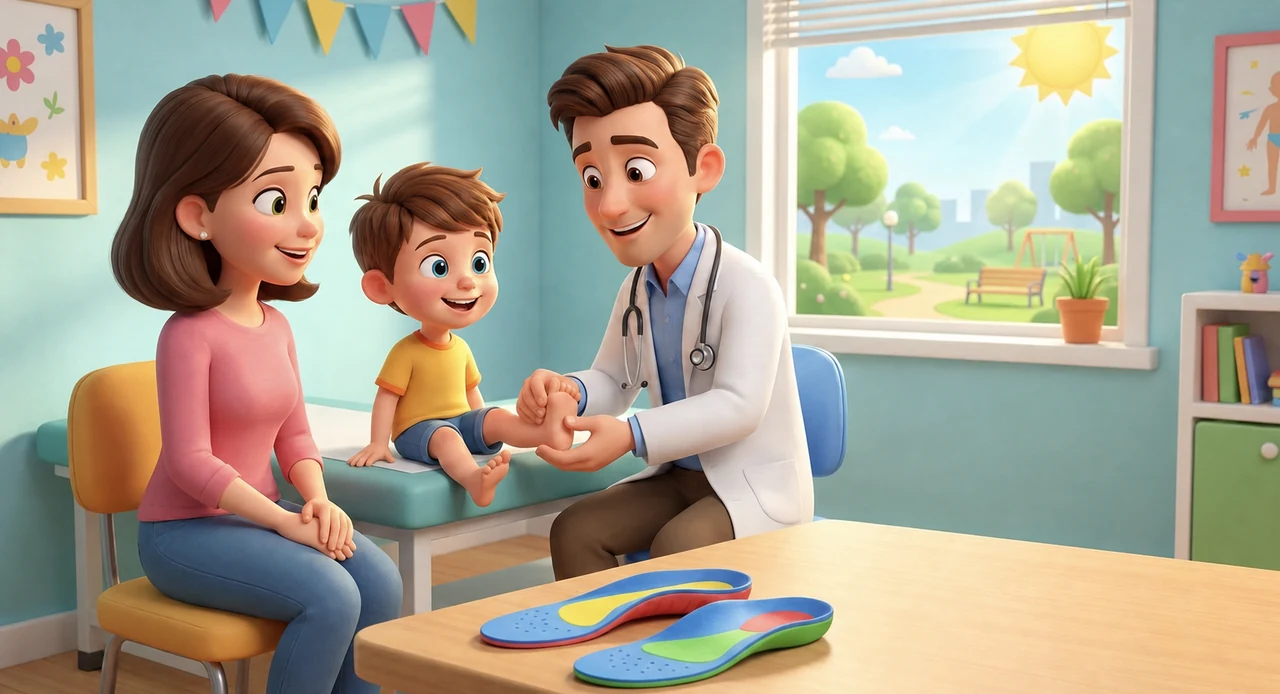
Flexible flatfoot is very common in children. If the arch reappears on tiptoes or when not bearing weight, and the child runs and plays without pain, in most cases, there is no need to treat the foot's shape.
Foot orthoses become more relevant when there is a symptom to improve: pain, fatigue, or difficulty during prolonged activities.
What Studies Show About Orthoses
The 2022 Cochrane Review primarily highlighted the limited quality and heterogeneity of available evidence. [1]
A 2024 meta-analysis of six randomized trials involving 297 children found improvements in some radiographic parameters and pain with orthoses. [2] In 2026, a network meta-analysis of 11 trials and 761 children confirmed effects on pain and some alignment measures; exercise-based interventions also showed benefits on certain parameters. [3]
These data support the use of foot orthoses as symptomatic treatment in selected cases. They do not demonstrate that an orthosis permanently transforms an asymptomatic flexible foot into a foot with a "normal" arch.
When I Consider Them
A foot orthosis may be reasonable in the presence of foot or ankle pain during activity, fatigue that limits walking or sports, symptomatic hindfoot valgus, or poor tolerance of prolonged loads.
The goal is to improve comfort and function. If the child does not benefit, continuing to change orthoses without re-evaluating the clinical picture makes little sense.
Custom-Made or Standard Orthoses
Not all children need a custom-made device. A simple, well-tolerated solution may be sufficient when the objective is primarily symptomatic.
Custom-made orthoses become more useful when the morphology is particular, symptoms are significant, a standard solution is ineffective, or specific control of foot support is needed.
When Flatfoot Requires a Different Approach
Stiffness, significant pain, marked asymmetry, or restricted movement of the subtalar joint may indicate conditions other than common flexible flatfoot, such as a tarsal coalition.
Limping, rapid modification of the deformity, persistent nocturnal pain, or neurological signs also require a broader evaluation.
Shoes, Exercises, and Stretching
Comfortable and activity-appropriate shoes can improve tolerance. Tightness of the gastrocnemius-Achilles complex may make dorsiflexion work useful; in some symptomatic children, strength and motor control exercises can be included in the treatment. [3]
A 2026 biomechanical review shows that orthoses modify plantar pressures, balance, muscle activity, and some joint parameters, but these changes do not necessarily equate to permanent structural correction. [4]
For flexible and painless feet, observation is often sufficient. When the child has symptoms, foot orthoses are one of the possible tools and should be judged based on the actual benefit they provide.
References
[1] Evans AM, Rome K, Carroll M, Hawke F. Foot orthoses for treating paediatric flat feet. Cochrane Database Syst Rev. 2022;1:CD006311.
[2] Liu C, Zhang H, Li J, et al. The effects of foot orthoses on radiological parameters and pain in children with flexible flat feet: a systematic review and meta-analysis. Front Pediatr. 2024;12:1388248. doi:10.3389/fped.2024.1388248. PMID: 39156020.
[3] Lin LY, Lin AC, Lai PC, et al. Effects of non-surgical interventions on standing posture and pain in children with flexible flatfoot: a network meta-analysis of randomized controlled trials. Phys Ther. 2026;106(5):pzag033. doi:10.1093/ptj/pzag033. PMID: 41921007.
[4] Zangi M, Taheri M, Ahmadi O, et al. Biomechanical effects of foot orthoses in children with flexible flat foot; a systematic review. 2026. PMID: 41883837.
Disclaimer: This content is for informational purposes only and does not replace an individual clinical evaluation.