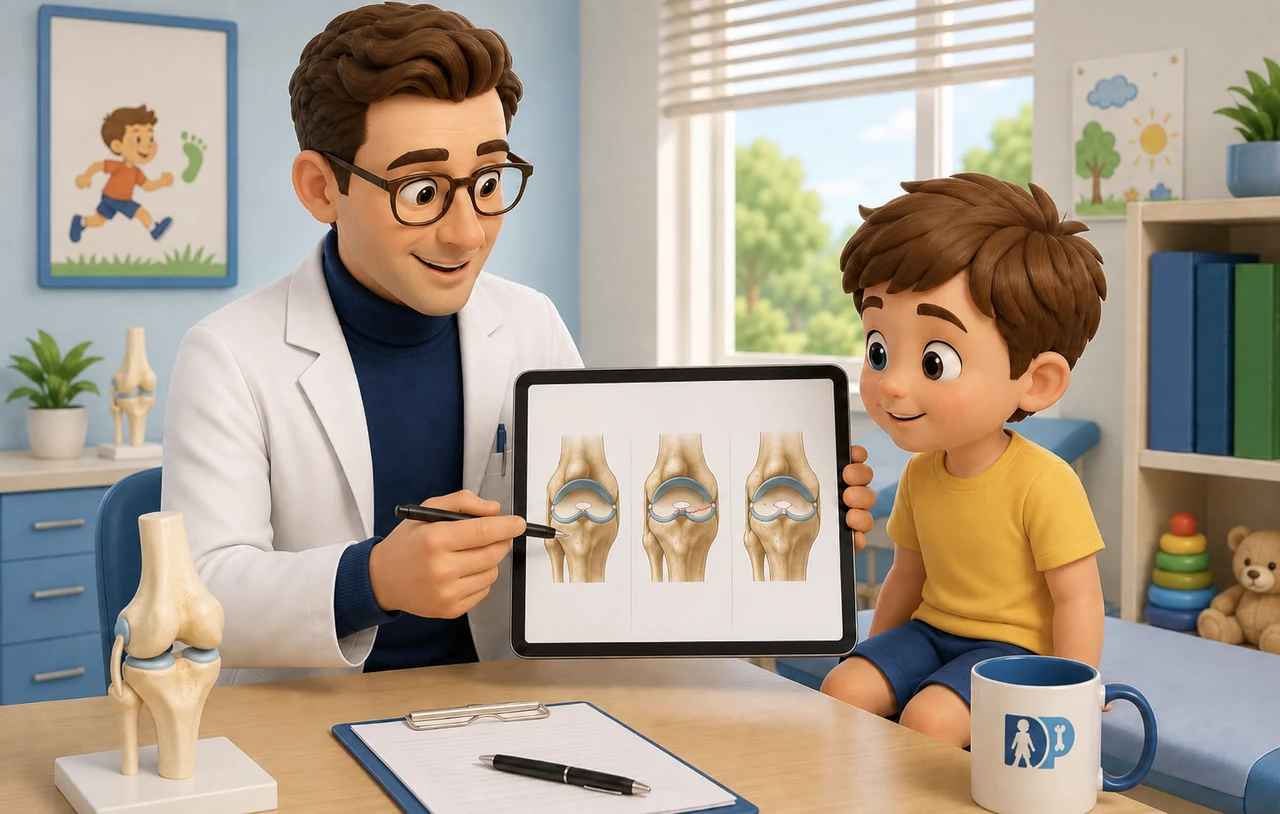
In symptomatic discoid lateral meniscus, saucerization serves to reshape the meniscus; suture is added when the peripheral rim is unstable or has a reparable lesion. For this reason, the results of the two procedures cannot be compared as if they involved comparable patients.
A 2026 systematic review collected pediatric outcomes of isolated saucerization, saucerization with repair, and more extensive meniscectomy [1]. Reoperation numbers are useful but must be read in conjunction with the initial characteristics of the meniscus.
The Study: 24 Papers, 1,225 Patients, and 1,401 Knees
Hartman and colleagues included 24 studies published between 2013 and 2023, totaling 1,225 patients and 1,401 knees. The average age of the children ranged from 8.3 to 13.7 years, and the average follow-up was between 1.2 and 10.1 years [1].
The surgical strategies analyzed were three:
- isolated saucerization;
- saucerization combined with repair;
- subtotal or total meniscectomy.
All techniques led to a significant improvement in functional scores, particularly the Lysholm score.
Isolated saucerization showed the lowest complication rate, at 2.7%, and reoperation rate, at 7.3%. Saucerization with repair had complications in 6.8% of cases and reoperations in 8.9% [1].
Isolated saucerization had fewer complications and reoperations, but the groups were not truly comparable.
Why More Reoperations After Suture Doesn't Mean Suture Is Wrong
Menisci that are sutured are often those that are most unstable, with peripheral lesions, capsular detachments, or more complex patterns.
These are not the same menisci subjected to simple saucerization.
A slightly higher revision rate after repair may reflect the greater complexity of the lesions treated with suture, not necessarily an unfavorable effect of the repair.
This is a classic problem of confounding by indication: more difficult cases receive the more complex treatment and end up having a higher probability of failure or revision.
Suture therefore makes sense when, after reshaping, peripheral instability or a reparable lesion remains. In those cases, repair is part of the meniscal preservation strategy.
What "Saucerization" Really Means
A discoid meniscus is wider and thicker than normal and occupies a larger portion of the lateral compartment.
When it becomes symptomatic, saucerization serves to reshape it by creating a peripheral rim more similar to the physiological one.
The goal is not to remove as much tissue as possible.
It is to leave a sufficiently stable, well-conformed, and functional meniscus.
For years, the classic treatment was total or subtotal meniscectomy. Today, this approach has been largely abandoned in children, because the loss of meniscal tissue exposes the joint to cartilage overload and articular degeneration over time.
The current goal is to preserve as much functional meniscal tissue as possible, without leaving an unstable rim.
The Decision Is Often Made During Arthroscopy
Magnetic resonance imaging helps a lot.
It can recognize discoid morphology, show an associated lesion, and suggest peripheral instability.
But it does not always establish the stability of the rim with certainty.
The definitive decision is often made during arthroscopy.
After saucerization, the surgeon uses a probe to evaluate:
- the stability of the peripheral rim;
- any capsular detachment;
- the presence of a vertical or complex lesion;
- the quality of the residual meniscal tissue;
- the ability of the meniscus to remain in place during knee movement.
If the rim is stable, a suture does not necessarily offer an advantage.
If, however, the meniscus lifts, shifts, or presents a reparable lesion, suture becomes an integral part of meniscal preservation.
Why the Reoperation Rate Doesn't Tell the Whole Story
A lower number of reoperations does not automatically equate to better treatment.
A more extensive meniscectomy can, in some cases, reduce the likelihood of a second arthroscopy in the short term.
But it can increase the risk of cartilage damage in subsequent years.
This is precisely the limitation of relatively short follow-ups.
Many studies included in the review stop at a few years, while the consequences of significant meniscal loss can emerge much later.
A case series with very long follow-up showed overall good clinical results after preservation treatment, but also a significant proportion of revisions over time [2].
This does not invalidate the principle of meniscal preservation.
Rather, it shows that symptomatic discoid meniscus is not always a problem solved once and for all with a single arthroscopy.
When to Operate on a Discoid Meniscus
A discoid meniscus discovered incidentally on MRI should not be automatically operated on.
Surgical treatment should be considered when consistent symptoms are present, especially:
- persistent pain;
- locking or catching episodes;
- painful clicking;
- limitation of movement;
- recurrent effusions;
- feeling of giving way;
- associated meniscal lesion.
An isolated asymptomatic click does not necessarily equate to a surgical indication.
As always, radiological data must be interpreted together with clinical findings.
Strengths of the Review
The review includes a large overall sample for a relatively uncommon pediatric pathology.
It analyzes not only functional scores but also complications and reoperations.
Furthermore, it confirms the paradigm shift in pediatric meniscal surgery: avoid total meniscectomy when possible and preserve the functional peripheral rim.
The work is also useful for counseling, as it offers concrete numbers to discuss with families.
Limitations Not to Be Ignored
The level of evidence remains low.
The included studies are predominantly retrospective, level III and IV. There are no randomized trials, and protocols are very heterogeneous.
They vary in:
- indications for suture;
- amount of residual meniscus;
- repair techniques;
- postoperative rehabilitation;
- duration of follow-up;
- definition of failure and revision.
The most important limitation, however, is the lack of comparability between groups.
We cannot read 7.3% and 8.9% as if they resulted from two treatments applied to the same lesion.
Sutured cases are often more complex from the outset.
The final decision is often made during arthroscopy, after reshaping the meniscus and verifying the stability of the peripheral rim. If the residual tissue is stable, saucerization may be sufficient; if it remains unstable or injured, repair becomes part of the treatment. The different reoperation rates in the review must be interpreted taking into account this case selection.
References
[1] Hartman H, Lessiohadi N, Saharan S, Saraf SM, Christiansen M, Mulcahey MK. Outcomes of Saucerization With or Without Repair for Symptomatic Discoid Lateral Meniscus in Pediatric Patients: A Systematic Review. Arthroscopy. Published online July 20, 2026. doi:10.1002/arj.70391. PMID: 42478088.
[2] Kim SJ, Kim DW, Min BH. Long-term outcome of arthroscopic partial meniscectomy with or without repair of discoid lateral meniscus in children. Knee Surg Sports Traumatol Arthrosc. 2012;20(8):1664-1670.
[3] Ahn JH, Lee YS, Ha HC. Arthroscopic partial meniscectomy with repair of the peripheral tear for symptomatic discoid lateral meniscus in children: results of minimum 2 years of follow-up. Arthroscopy. 2008;24(8):888-898.
[4] Good CR, Green DW, Griffith MH, Valen AW, Widmann RF, Rodeo SA. Arthroscopic treatment of symptomatic discoid meniscus in children: classification, technique, and results. Arthroscopy. 2007;23(2):157-163.
Disclaimer: content for general informational purposes only. It does not replace a medical evaluation.