Flatfoot Surgery: post-operative pathway after subtalar arthroereisis
Post-operative pathway for the four most frequent surgical variants of flexible paediatric flatfoot — endosinotarsal arthroereisis, exosinotarsal arthroereisis, arthroereisis with Achilles tendon lengthening and arthroereisis with accessory navicular excision — with particular emphasis on early active and passive mobilisation of the foot and ankle.
Active and passive mobilisation from day 2 · Crutches until suture removal (~2 weeks) · Running and jumping after 45 days · Sport at 2 months (3 months if Achilles lengthening)
These documents are protocol templates for information and education only: they do not replace the rehabilitation prescription for the individual case. Timing, loading and progressions must always be adapted to the patient, the lesion pattern, the surgical technique used and the clinical course, in collaboration between orthopaedic surgeon, physiotherapist and, where appropriate, physiatrist. Progression is driven by objective criteria, not by the calendar alone.
The most widely used operation for flexible paediatric flatfoot is subtalar arthroereisis: a screw (or a dedicated implant) is placed in the sinus tarsi, the virtual space between talus and calcaneus, to limit hindfoot collapse into valgus-pronation and restore the medial arch. It is not a definitive mechanical straightening: the implant acts as a proprioceptive block that redirects load, while the foot progressively learns to work in its new position.
For this reason rehabilitation matters as much as surgery. The central message of this pathway is early mobilisation, both active and passive, of the foot and ankle: from the second day — and in any case as soon as pain allows — the ankle joint and the toes must be moved through their whole available range. Early motion reduces oedema because the calf muscle pump starts working again, prevents scar adhesions around the sinus tarsi, maintains the trophism of the intrinsic foot muscles and limits subtalar stiffness, which is the most frequent and most troublesome functional complication after this procedure.
Mobilisation should be understood in two complementary ways. Active mobilisation is what the child performs alone: ankle dorsi-plantar flexion, clockwise and anticlockwise circles, toe movement, towel grasping. Passive mobilisation is performed by the parent or physiotherapist (or by the patient with a belt): the joint is gently taken to its end range without provoking pain, especially into dorsiflexion, where the triceps surae tends to tighten again. The two are not alternatives: passive work gains range, active work stabilises it and makes it usable during gait.
The pathway varies with the technique used. With endosinotarsal arthroereisis the screw sits inside the sinus tarsi: for the first 72 hours weight bearing is limited to a few metres, with the limb elevated and iced, then walking with two crutches is allowed. With exosinotarsal arthroereisis the screw passes through the calcaneus: assisted weight bearing with crutches is allowed straight after discharge. When arthroereisis is combined with Achilles tendon lengthening (indicated when true triceps surae shortening prevents dorsiflexion with the knee extended) a below-knee cast is applied for about 30 days and tendon healing dictates the timeline; this procedure is usually performed one foot at a time. When an accessory bone (painful accessory navicular) is excised, the cast is shorter, usually 15 days.
One piece of information worth giving families before surgery: in the first months the child may walk in an odd way, loading the outer border of the foot. This is neither a surgical error nor a sign of overcorrection: it is the physiological adaptation to a hindfoot that no longer collapses medially. It resolves spontaneously with time and exercise, and does not require corrective insoles unless otherwise indicated.
This document is a protocol template. The times given are indicative and progression must always be adapted to the individual patient by the operating surgeon together with the physiotherapist and/or physiatrist.
Key parameters
- Weight bearing — endosinotarsal arthroereisis
- First 72 hours: only a few metres, a wheelchair or stroller is advised, foot elevated and iced. From day 3, walking with 2 crutches until suture removal (about 2 weeks), then free walking.
- Weight bearing — exosinotarsal arthroereisis
- Walking with 2 crutches from discharge, foot elevated and iced in the first days; crutches discontinued at suture removal (about 2 weeks).
- Weight bearing — arthroereisis + Achilles lengthening
- Walking with 2 crutches bearing weight on the operated foot, below-knee cast with a cast shoe for about 30 days; free walking after cast removal. Usually one foot at a time.
- Weight bearing — arthroereisis + accessory bone
- Walking with 2 crutches bearing weight on the operated foot, below-knee cast for about 15 days; normal walking once cast and sutures are removed.
- Active mobilisation
- From day 2 (or from cast removal in casted variants): ankle dorsi-plantar flexion and circles in both directions, toe motion, foot alphabet. 20 seconds of continuous motion x 10 times a day.
- Passive mobilisation
- From day 2: static calf stretch with a bathrobe belt, knee extended, 30 seconds x 10 repetitions a day; gentle parent-assisted mobilisation of ankle and toes, pain free.
- Surgical wound
- Keep dry until suture removal (about 2 weeks). If the dressing peels off, replace it after cleaning with a povidone-iodine antiseptic.
- Running and jumping
- Not allowed for the first 45 days after isolated arthroereisis. Gradual resumption after day 45, with normal gait and no pain.
- Return to sport
- Sport at about 2 months after isolated arthroereisis; at least 2 months (in practice 2-3) when the Achilles tendon has been lengthened, always with restored dorsiflexion and symmetrical foot contact.
- Night splint
- Only in the Achilles-lengthening variant: a night splint for a further 30 days after cast removal, to maintain the length obtained.
Endosinotarsal vs exosinotarsal arthroereisis: what changes after surgery
Both techniques place a screw to support the hindfoot, but the implant site changes how the foot can be loaded in the very first days. Early active and passive mobilisation, however, is identical and mandatory in both.
| Endosinotarsal (screw in the sinus tarsi) | Exosinotarsal (screw through the calcaneus) | |
|---|---|---|
| Weight bearing in the first 72 hours | Not advised beyond a few metres: wheelchair or stroller, foot elevated and iced. | Walking with 2 crutches allowed from discharge, with elevation and ice in the first days. |
| Crutches | From day 3 until suture removal (about 2 weeks). | From discharge until suture removal (about 2 weeks). |
| Start of exercises | From day 2: active and passive mobilisation of ankle and toes. | From day 2: active and passive mobilisation of ankle and toes. |
| Cast | Not used in the isolated procedure. | Not used in the isolated procedure. |
| Running and jumping | Not allowed for 45 days. | Not allowed for 45 days. |
| Outer-border walking | Possible for some months: physiological adaptation to the correction. | Possible for some months: physiological adaptation to the correction. |
Associated variants mainly change the timeline: with Achilles lengthening a below-knee cast is worn for about 30 days (plus a night splint for a further 30 days, sport after at least 2 months); with accessory navicular excision the cast lasts about 15 days.
Loading timeline
Milestones at a glance
- Day 2Start of active and passive foot mobilisation
- Day 3Walking with 2 crutches (endosinotarsal)
- 2 weeksSutures out, wound washing, walking without crutches
- Days 15-30Cast removal in accessory-bone or Achilles-lengthening variants
- Weeks 3-4Foot strengthening, proprioception, elastic bands
- Day 45Return to running and jumping
- Month 2Return to sport
- Months 18-36Possible removal of the arthroereisis screw
Phases of the pathway
Phase 1 — First 72 hours: swelling, pain and wound protection
Days 0-3
Goals
- •Control swelling and pain
- •Protect the surgical wound and the implant
- •Start toe motion and calf contractions
What to do
- •Limb elevated above heart level whenever sitting or lying, as much as possible in the first 72 hours
- •Ice pack (never directly on the skin) 15-20 minutes, 4-6 times a day
- •Endosinotarsal arthroereisis: avoid walking more than a few metres; use a wheelchair or stroller for transfers
- •Exosinotarsal arthroereisis: walking with 2 crutches already allowed, still limiting distances to essential needs
- •Casted variants (Achilles lengthening, accessory bone): walking with 2 crutches bearing weight on the cast with a cast shoe
- •Active toe motion and isometric calf contractions (venous pump) several times a day, also inside the cast
- •Analgesia as prescribed, anticipating pain before mobilisation sessions
Restrictions and precautions
- •Keep the wound and the cast dry
- •No full weight bearing without crutches
- •Do not remove the dressing unnecessarily; if it peels off, clean with povidone-iodine
Criteria to progress
- ☐Pain controlled with prescribed medication
- ☐Swelling decreasing with elevation and ice
- ☐Dry wound without discharge
Note for the physiotherapist
In this phase the physiotherapist educates the family: elevation, ice, correct crutch use and toe motion. No forced manoeuvres on the foot.
Phase 2 — Early active and passive mobilisation
From day 2-3 to suture removal (about 2 weeks)
Goals
- •Restore ankle dorsi-plantar flexion and foot rotation
- •Prevent adhesions and subtalar stiffness
- •Maintain trophism of the intrinsic foot muscles
- •Walk safely with two crutches
What to do
- •ACTIVE MOBILISATION (child alone): ankle flexion-extension and circles, first clockwise then anticlockwise, with a gentle, wide and complete movement — 20 seconds of motion, 10 times a day
- •Foot alphabet: “write” the letters in the air with the big toe, 1-2 alphabets 2-3 times a day
- •PASSIVE MOBILISATION (with a bathrobe belt, sitting on the floor with the knee extended): belt at the base of the toes, gentle pull towards yourself until tension is felt in the tendon, without pain — 30 seconds, 10 repetitions a day
- •Parent-assisted passive mobilisation: one hand stabilises the heel, the other guides the foot into dorsiflexion, plantarflexion and gentle inversion/eversion, always within the pain limit
- •Mobility and grip: scrunch a towel with the toes, pick up and move small objects (marbles, caps) into a container — 5 minutes a day, as play
- •Walking with 2 crutches according to the surgical variant, with heel strike and the most physiological roll-over possible
- •Casted variants: mobilisation involves toes, knee and hip; the full ankle programme starts at cast removal
Restrictions and precautions
- •No painful manoeuvres: pain is the limit of mobilisation, not a target
- •No running, jumping or sport
- •Wound and cast kept dry
Criteria to progress
- ☐Active and passive dorsiflexion improving day by day
- ☐Mobile toes able to grasp the towel
- ☐Walking with crutches without marked antalgic limp
- ☐Wound healing without signs of infection
Note for the physiotherapist
This is the key phase of the protocol: the window in which range of motion is gained (or lost). Ten short sessions a day beat one long one.
Phase 3 — Suture removal, crutch weaning and return to walking
From about 2 weeks (Achilles variant: after cast removal, about 30 days; accessory bone: about 15 days)
Goals
- •Walk normally without aids
- •Complete recovery of range of motion
- •Reactivate the calf and tibialis posterior
What to do
- •After suture removal the wound can be washed, crutches abandoned and normal walking resumed
- •Daily continuation of active and passive ankle mobilisation and belt stretching
- •Dynamic band stretching (TheraBand type) anchored to a fixed support: resisted dorsiflexion, plantarflexion, inversion and eversion — 15 movements per direction daily, increasing resistance as it becomes easy
- •Achilles-lengthening variant: dedicated wall calf stretch (knee extended and knee flexed) plus a night splint for a further 30 days
- •Toe grip and mobility exercises maintained as daily play
- •Cycling and swimming (once the wound is fully healed) as low-impact aerobic activities
Restrictions and precautions
- •No running or jumping until day 45 (isolated arthroereisis)
- •Avoid very uneven ground and games with sharp direction changes
Criteria to progress
- ☐Independent walking without crutches and without significant pain
- ☐Dorsiflexion similar to the non-operated side (or clearly improving in Achilles variants)
- ☐No significant end-of-day swelling
Note for the physiotherapist
If dorsiflexion remains limited, intensify passive work before increasing load: early stiffness is far easier to prevent than to reverse.
Phase 4 — Strengthening, proprioception and gait retraining
From week 3-4 to day 45 (Achilles variant: from month 2)
Goals
- •Strengthen tibialis posterior, peroneals and intrinsic foot muscles
- •Restore single-leg balance
- •Normalise foot contact, reducing walking on the outer border
What to do
- •Short foot exercise: shorten the foot by drawing the forefoot towards the heel without curling the toes, 10 reps of 5 seconds, 3 times a day
- •Toe yoga: lift the big toe keeping the others down and vice versa, 10 reps each way
- •Tibialis posterior strengthening with a band in resisted inversion, 3 sets of 15
- •Calf raises, double-leg then progressively single-leg, 3 sets of 10-15
- •Single-leg balance: 3 x 30 seconds, then on a cushion or wobble board, finally with eyes closed
- •Heel walking and toe walking alternated for 10-15 metres, as daily play
Restrictions and precautions
- •Still no running, jumping or team sport before day 45
Criteria to progress
- ☐Single-leg heel raise performed with the heel inverting
- ☐Single-leg balance ≥30 seconds
- ☐More symmetrical foot contact with less outer-border walking
Note for the physiotherapist
Walking on the outer border of the foot is an expected adaptation: it is corrected with proprioception and strengthening, not by forcing eversion passively.
Phase 5 — Return to running, jumping and sport
From day 45 (isolated arthroereisis) · From month 2 in the Achilles-lengthening variant
Goals
- •Progressively resume running and jumping
- •Return to the chosen sport without pain or reactive swelling
What to do
- •Running progression: brisk walking, then walk/jog alternation, then continuous running on even ground
- •Introduction of jumping: double-leg hops, then single-leg, then jumps with direction changes
- •Return to team training before matches/competition
- •Daily maintenance of calf stretching and intrinsic foot exercises
Restrictions and precautions
- •Stop the progression if sinus tarsi pain or swelling persisting the next day appears
Criteria to progress
- ☐Continuous running for 10-15 minutes without pain
- ☐Symmetrical single-leg hop compared with the healthy side
- ☐No swelling the morning after activity
Note for the physiotherapist
In children progression often happens spontaneously during play: the physiotherapist’s role is more to contain than to push.
Phase 6 — Follow-up and implant management
From month 3 until screw removal
Goals
- •Maintain the correction obtained and a mobile foot
- •Monitor implant tolerance
- •Plan screw removal when indicated
What to do
- •Scheduled clinical review assessing foot contact, dorsiflexion and sinus tarsi pain
- •Long-term maintenance of calf stretching and short-foot exercises, especially in high-impact sports
- •Comfortable shoes with a supportive heel counter; insoles only if specifically prescribed
- •The arthroereisis screw is not permanent: it is usually removed later (generally after 18-36 months, or once correction has stabilised), with a short procedure and rapid return to walking
Criteria to progress
- ☐Pain-free foot with a maintained arch on weight bearing
- ☐Full and symmetrical ankle range of motion
- ☐Sport performed without limitations
Return to sport / full activity
About 2 months after isolated arthroereisis (running and jumping from day 45) · At least 2 months, in practice 2-3, when the Achilles tendon has been lengthened
- ☐Normal gait, without limp and without predominant outer-border loading
- ☐Ankle dorsiflexion symmetrical to the other side (knee-to-wall test)
- ☐Single-leg heel raise x 10 repetitions without pain
- ☐Single-leg balance ≥30 seconds, including on an unstable surface
- ☐Continuous running for 10-15 minutes and symmetrical single-leg hop, without sinus tarsi pain
- ☐No swelling the day after sport-level loading
In Achilles-lengthening variants the limiting factor is triceps surae strength: resuming jumping requires recovery of the single-leg heel raise, which may come later than range of motion.
Red flags: stop and contact us
- •Fever, spreading redness, discharge or bad smell from the wound (suspected infection)
- •Pain that increases instead of decreasing after the first days, or is not controlled by prescribed analgesics
- •Marked swelling not settling with elevation and ice, or a hard, painful calf
- •Persistent pins and needles, numbness, or cold, pale or bluish toes (cast or dressing too tight: seek advice immediately)
- •Progressive inability to move the ankle, or stiffness worsening despite exercises
- •Persistent focal pain in the sinus tarsi (in front of and below the lateral malleolus) not improving after month 2: possible implant intolerance
- •Cast broken, wet or rotating on the limb
- •In the Achilles-lengthening variant: sudden loss of push-off strength or inability to rise on tiptoe after cast removal
Guidelines and literature
- Schema post-operatorio “Intervento per Piede piatto” — Ortopedia e Traumatologia Pediatrica, Istituto Ortopedico Gaetano Pini, Milano.
- Bresnahan PJ, Chariton JT, Vedpathak A. Extraosseous talotarsal stabilization using HyProCure: preliminary clinical outcomes. J Foot Ankle Surg.
- Metcalfe SA, Bowling FL, Reeves ND. Subtalar joint arthroereisis in the management of pediatric flexible flatfoot: a critical review of the literature. Foot Ankle Int 2011.
- Chong DY et al. Surgical treatment of symptomatic flexible pes planovalgus in children: outcomes and complications.
- Herzenberg JE, Lamm BM. Gastrocnemius recession and Achilles lengthening: indications and post-operative management.
Key exercises, step by step
Each exercise belongs to a specific phase: do not anticipate them. Dosage is indicative and must be adapted by your physiotherapist.
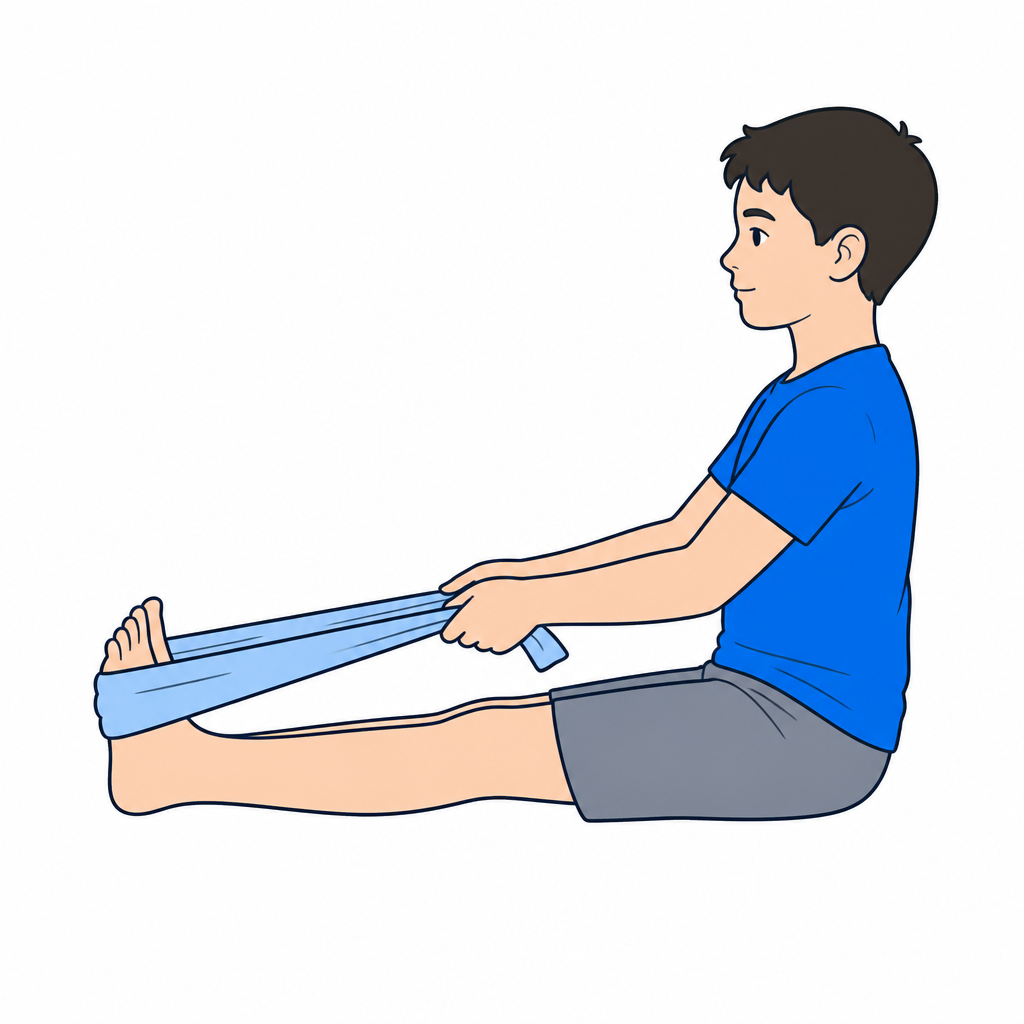
1. Static belt stretch (passive mobilisation)
From day 2
- •Sit on the floor with a straight back and knees fully extended.
- •Loop a bathrobe belt around the base of the toes of the operated foot.
- •Pull gently towards you until you feel tension in the Achilles tendon, never pain.
- •The knee must stay straight: if it bends, the stretch does not reach the tendon.
Dosage: Hold 30 seconds, 10 repetitions every day
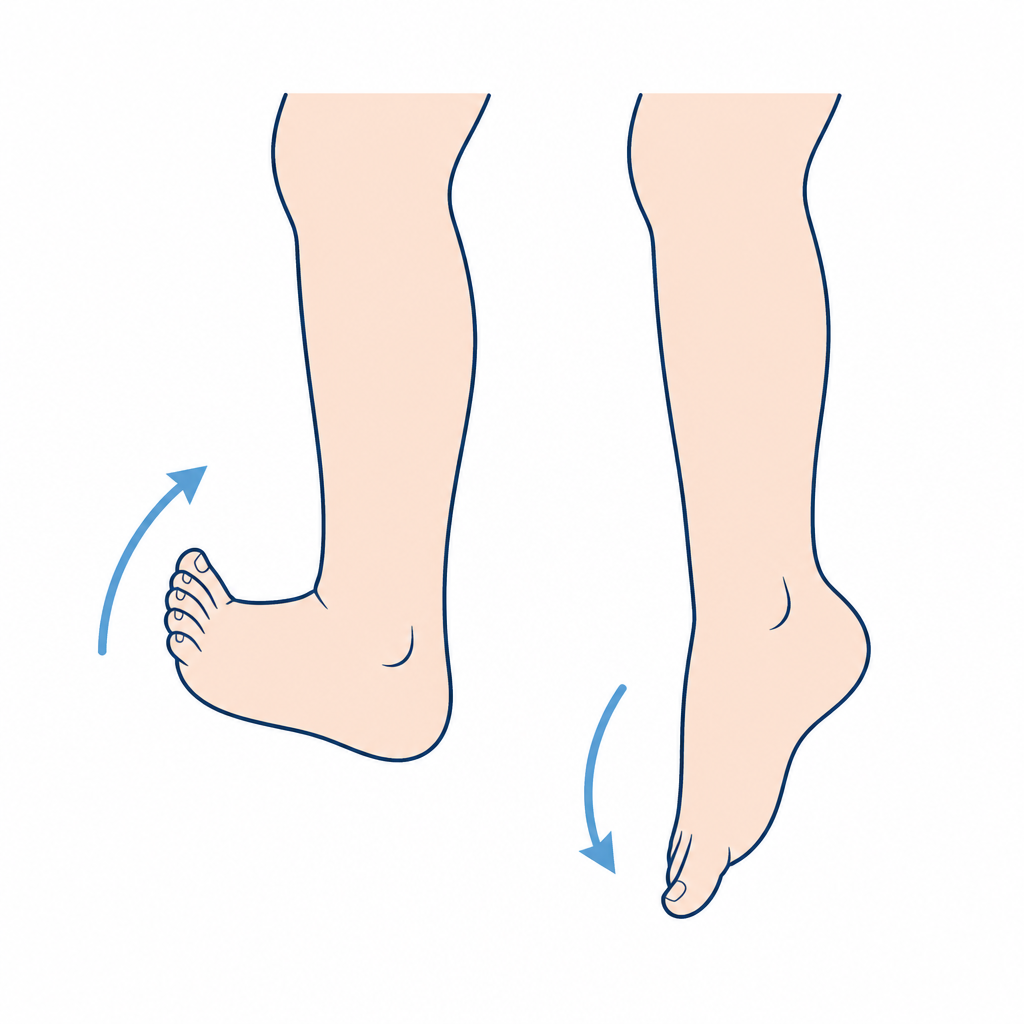
2. Active ankle mobilisation
From day 2
- •Sitting or lying, move the ankle (not just the toes) pulling the foot up and then pointing it down.
- •Then draw wide circles with the foot, first clockwise then anticlockwise.
- •The movement must be gentle, wide and complete, up to the pain-free limit.
Dosage: 20 seconds of continuous motion, 10 times a day
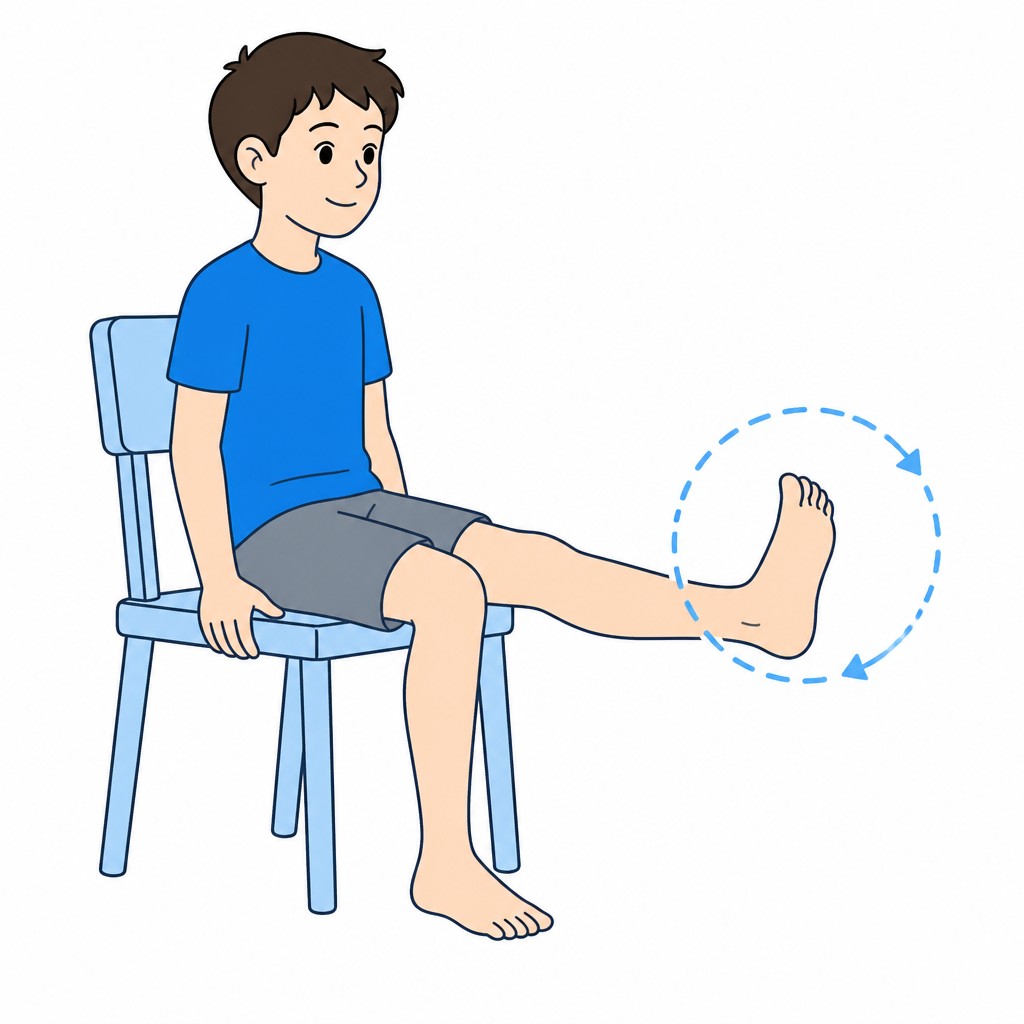
3. Foot alphabet
From day 2-3
- •With the leg supported and the foot free in the air, “write” the alphabet letters with the big toe.
- •Move only the ankle, keeping the knee still.
- •Make big letters: they are meant to explore the whole range of motion.
Dosage: 1-2 alphabets, 2-3 times a day
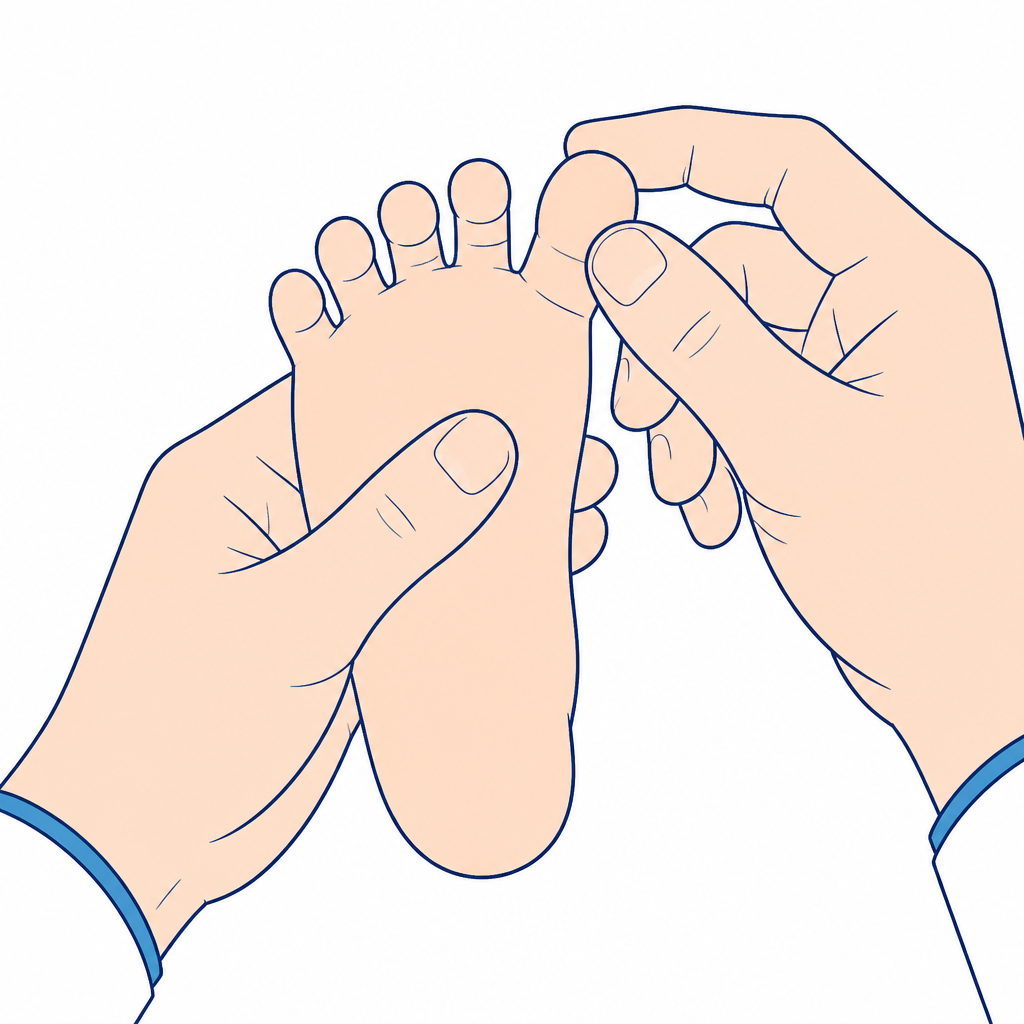
4. Toe mobility
From day 1-2, also inside the cast
- •Open and close the toes, then try to lift only the big toe and then only the others.
- •If a cast is in place, still move the toes that remain free.
- •It is the simplest way to activate the venous pump and reduce swelling.
Dosage: 20 repetitions, 5-6 times a day
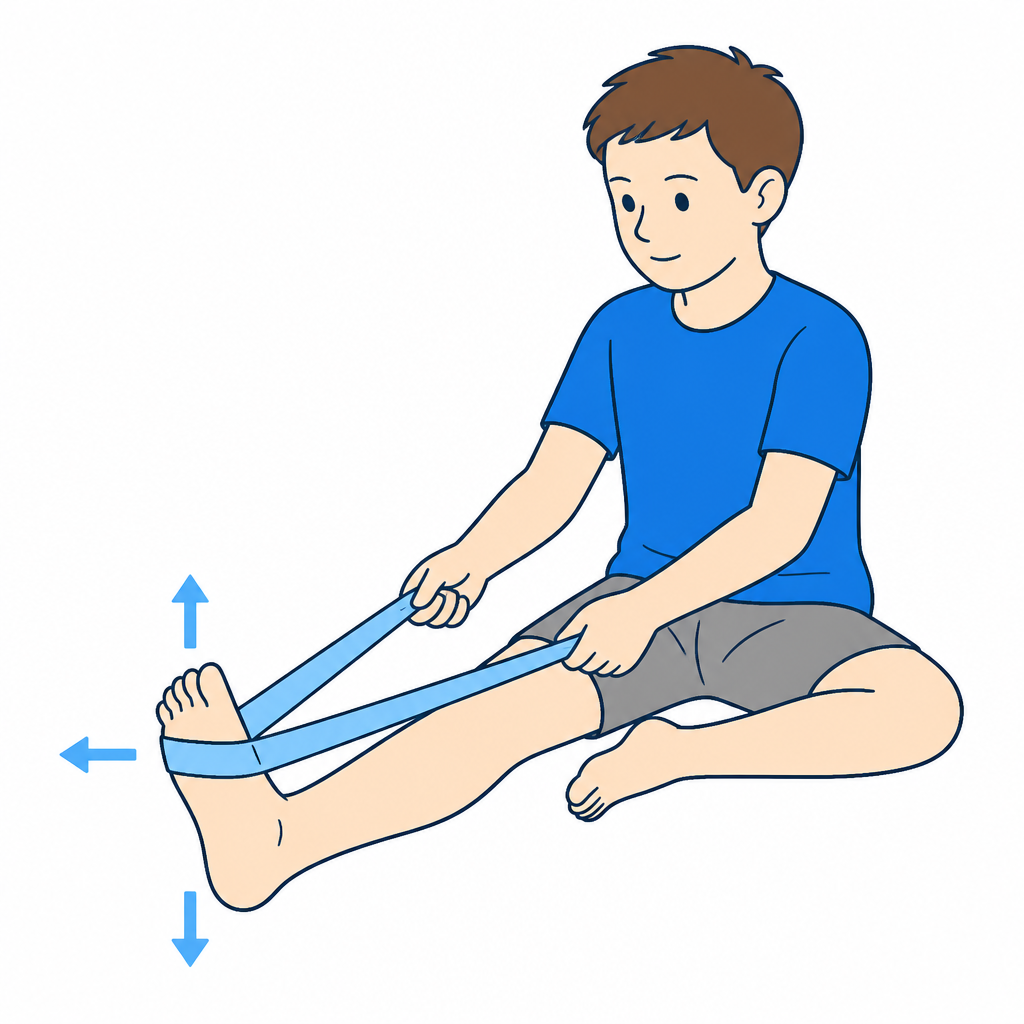
5. Dynamic band stretching (4 directions)
From suture removal
- •Anchor an elastic band (TheraBand type) to a fixed support such as a table leg.
- •Move against the band’s pull: foot up, foot down, inwards, outwards.
- •Control the return: the slow part of the movement is what strengthens most.
- •Increase resistance (a stiffer band) once the exercise feels easy.
Dosage: 15 movements per direction, every day
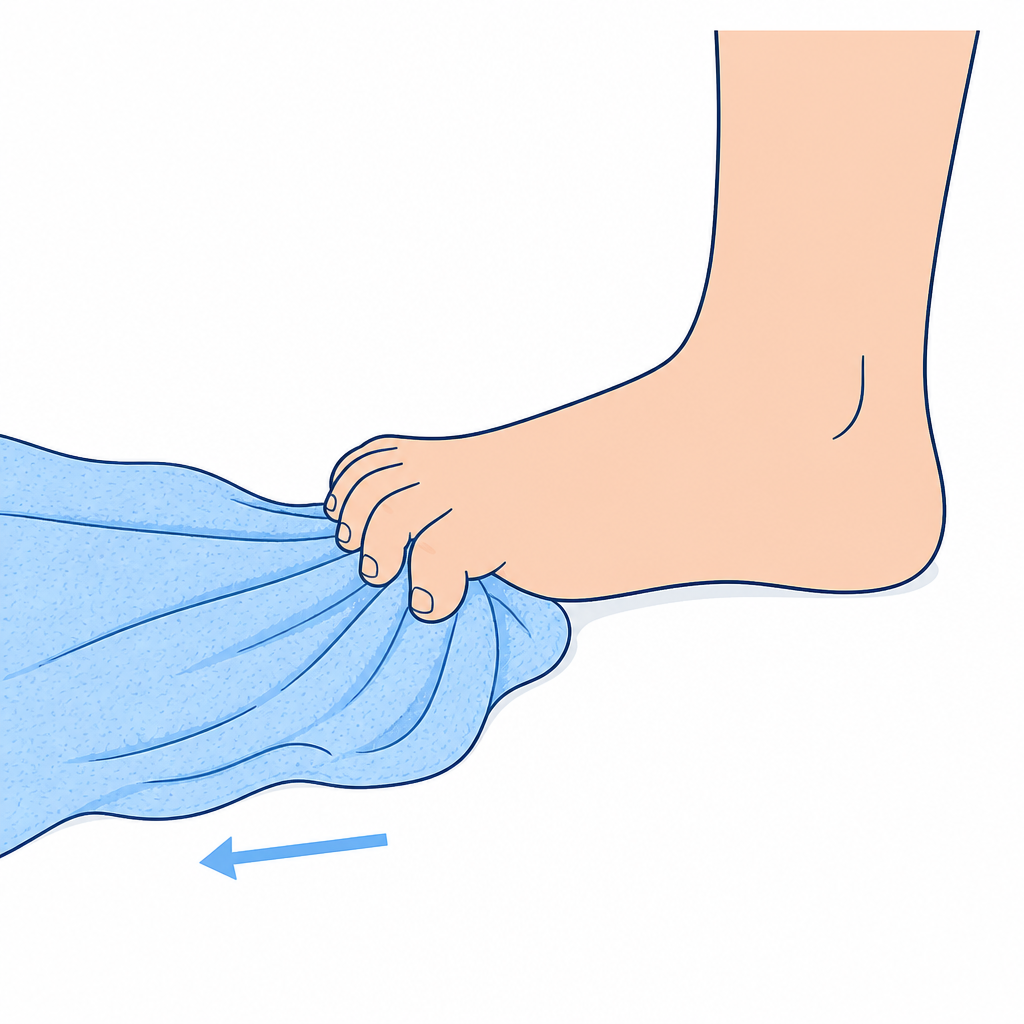
6. Towel curls
From day 2
- •Sitting, place the foot on a towel spread on the floor.
- •Scrunch the towel towards you using only the toes, without lifting the heel.
- •Then try to grasp it and move it sideways.
Dosage: 5 minutes a day
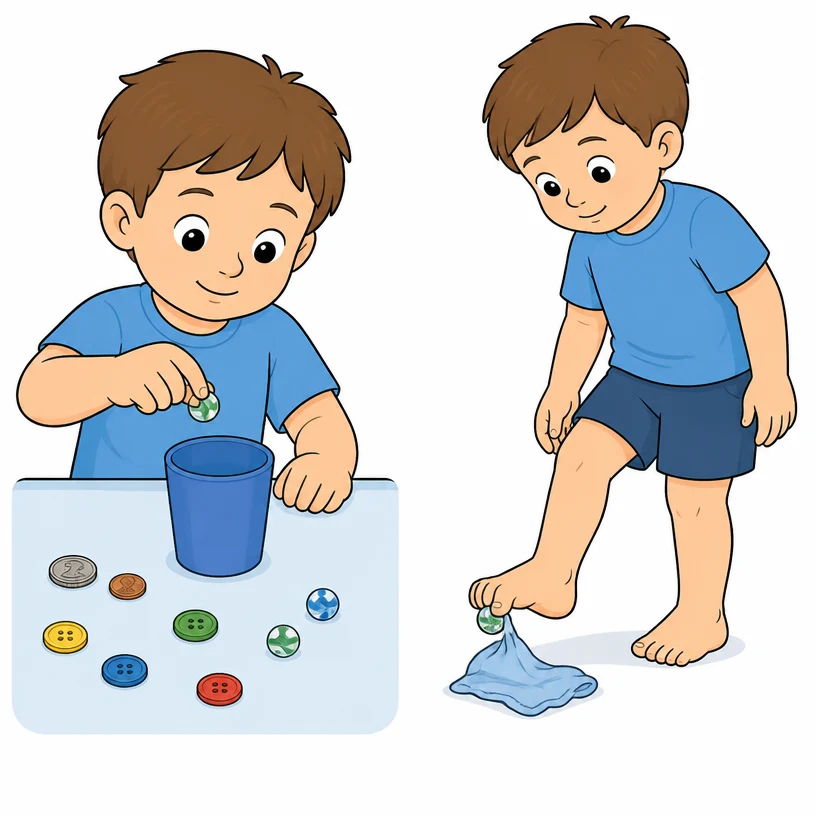
7. Picking up small objects
From day 2
- •Scatter marbles, bottle caps or small bricks on the floor.
- •Grasp each object with the toes and drop it into a container.
- •It works best as a timed game: how many objects in 2 minutes?
Dosage: 5 minutes a day
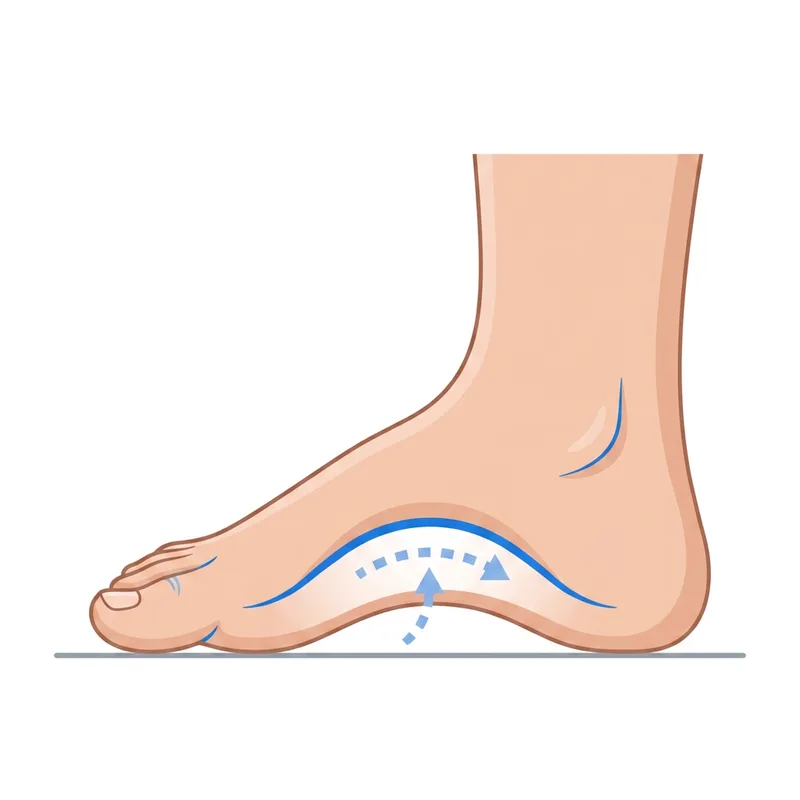
8. Short foot exercise
From week 3-4
- •Sitting with the foot flat on the floor, heel and toes in contact.
- •Draw the forefoot towards the heel, “shortening” the foot and lifting the arch, without curling the toes.
- •The toes stay long and relaxed: if they curl, you are using the wrong muscles.
Dosage: 10 repetitions of 5 seconds, 3 times a day
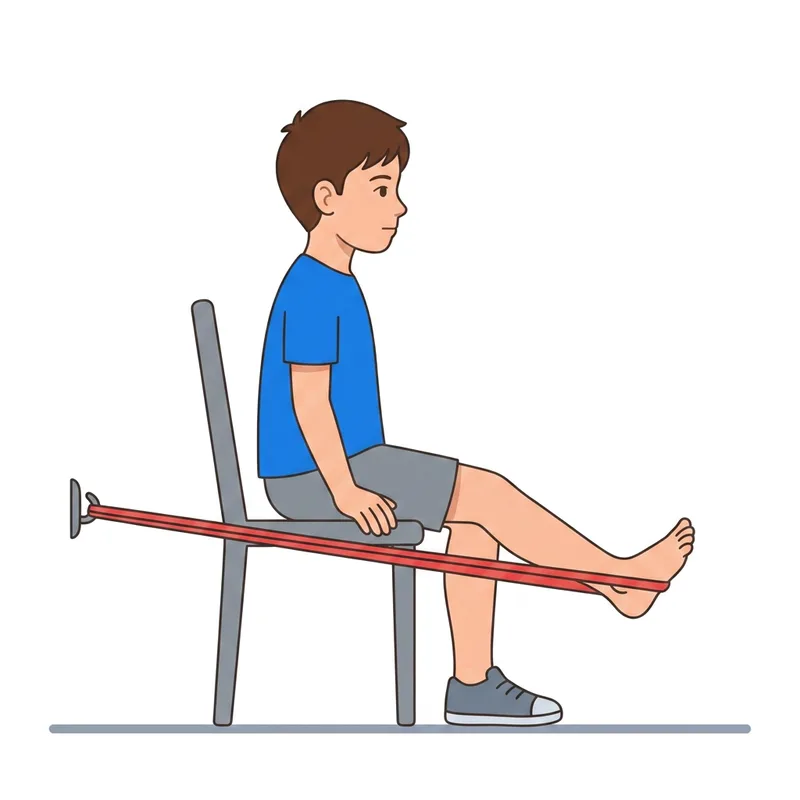
9. Tibialis posterior strengthening with a band
From week 3-4
- •Band anchored to the side, looped around the forefoot.
- •Move the foot inwards and downwards against the resistance, keeping the knee still.
- •Return to the start position slowly, over 3 seconds.
Dosage: 3 sets of 15, daily
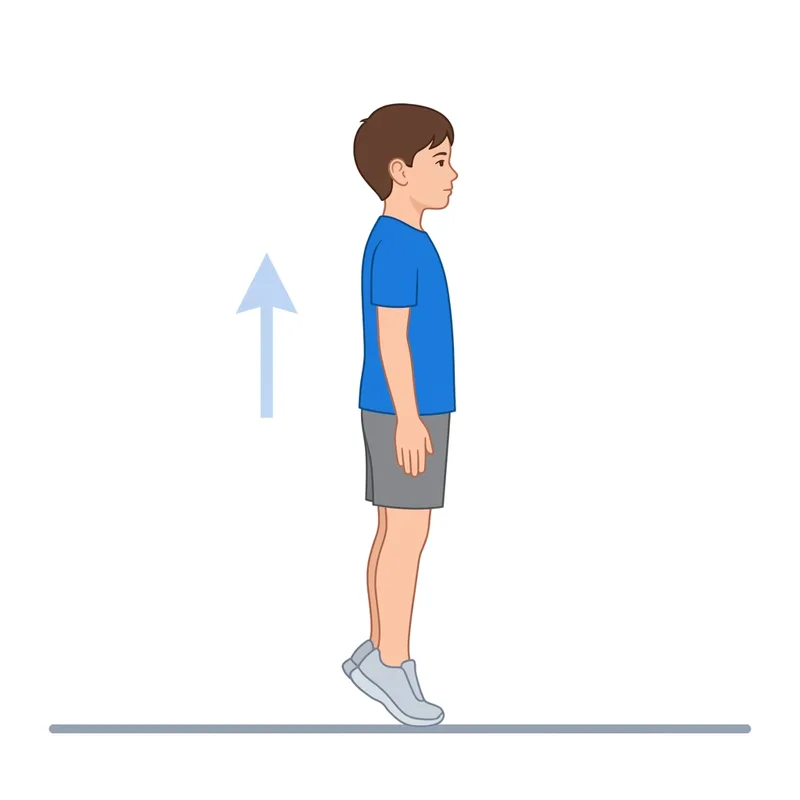
10. Calf raises
From week 4 (after cast removal in casted variants)
- •Standing, hands on a wall for balance.
- •Rise onto the toes keeping the heels aligned, then lower slowly over 3 seconds.
- •When it becomes easy, perform it on one leg only.
Dosage: 3 sets of 10-15, daily
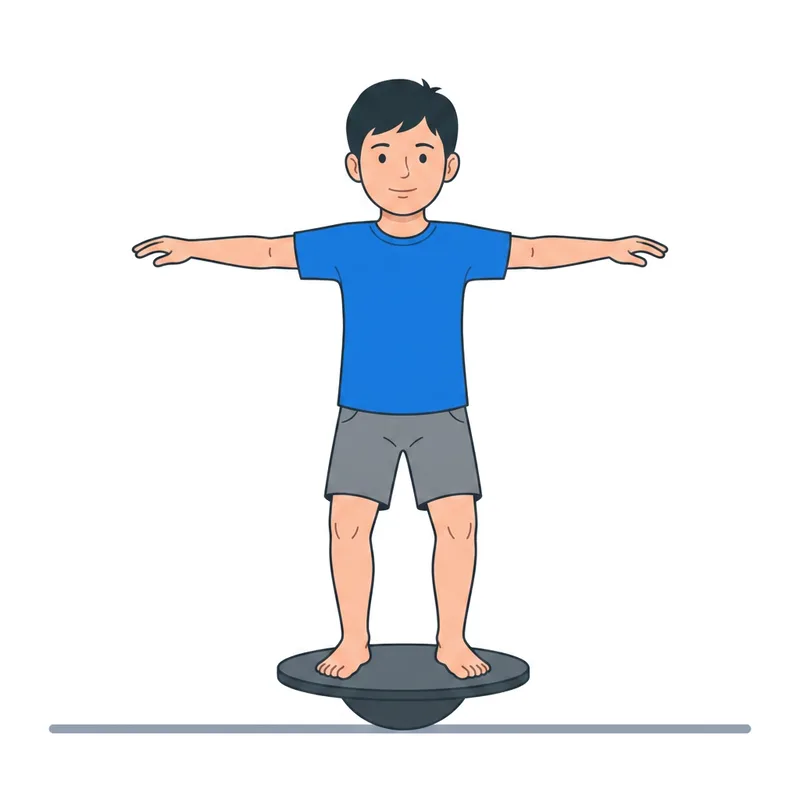
11. Balance on an unstable surface
From week 4-5
- •Stand on a cushion or wobble board on one leg.
- •Knee slightly bent, pelvis level, eyes forward.
- •Progression: eyes closed, then ball throwing, then light perturbations.
Dosage: 3 x 30 seconds per side, daily
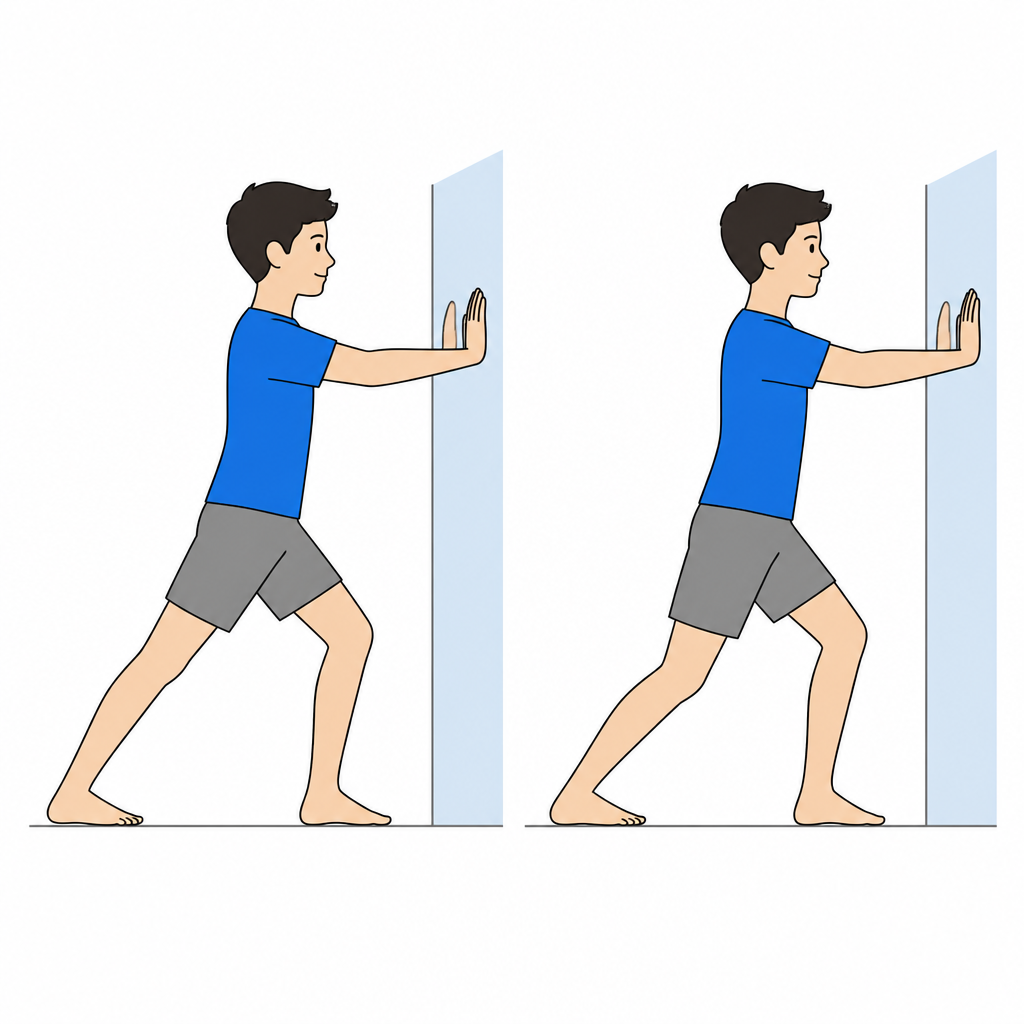
12. Wall calf stretch (two positions)
From return to free walking
- •Hands on the wall, operated leg behind, heel firmly on the floor.
- •First position: back knee straight (stretches gastrocnemius).
- •Second position: back knee slightly bent (stretches soleus).
- •The heel must never lift off the floor.
Dosage: 3 x 30 seconds per position, daily
Frequent questions
Why is moving the foot from day 2 so important?
Because early motion does three things no drug does: it reactivates the muscle-venous pump and therefore reduces swelling, it prevents the deep scar around the sinus tarsi from forming adhesions, and it keeps the intrinsic foot muscles active. Subtalar stiffness is the most frequent functional complication after arthroereisis, and it is far easier to prevent than to treat.
What is the difference between active and passive mobilisation?
Active means the child moves the foot with their own muscles: flexion-extension, circles, alphabet, towel curls. Passive means the motion is produced externally, by the parent, the physiotherapist or a belt, with the muscle relaxed. Both are needed: passive work gains degrees of range, active work makes them usable during gait.
The child walks on the outer border of the foot: is that a problem?
No. It is the physiological adaptation to a hindfoot that no longer collapses inwards, and it can last a few months. It resolves on its own with walking and with proprioception and strengthening exercises. It should be reported to the surgeon only if accompanied by persistent pain on the outer side of the ankle.
When can crutches be discontinued?
Usually at suture removal, around 2 weeks, both with the endosinotarsal and the exosinotarsal technique. In casted variants they are discontinued at cast removal: about 15 days for accessory navicular excision, about 30 days for Achilles tendon lengthening.
Can the wound get wet?
No, not until suture removal (about 2 weeks). If the dressing peels off earlier, it can be replaced after cleaning the wound with a povidone-iodine antiseptic. After suture removal the wound can be washed normally.
Why is Achilles lengthening usually done one foot at a time?
Because that foot wears a below-knee cast for about a month and calf push-off is temporarily weakened: operating both sides together would make independent walking very difficult. Doing one foot at a time keeps a reliable support limb.
What is the night splint for?
It is used only after Achilles tendon lengthening, for a further 30 days after cast removal. It maintains overnight the length obtained surgically, because a healing tendon tends to shorten again if the foot stays pointed for many hours.
Does the screw need to be removed?
The arthroereisis implant is not intended to stay forever: it is usually removed later, generally after 18-36 months or once correction has stabilised, with a short procedure and rapid return to walking. The exact timing is decided by the surgeon based on growth and clinical review.
Are insoles needed after surgery?
As a rule no: correction is provided by the implant and the foot must learn to work in its new position. Comfortable shoes with a good heel counter are useful. Insoles are prescribed only in selected cases, on the surgeon’s indication.
When can the child return to school and PE?
School usually after suture removal, once walking is independent, avoiding stairs and frequent transfers in the first weeks. PE resumes for running and jumping after day 45, and fully at around 2 months (2-3 months if the Achilles tendon was lengthened).
Flatfoot Surgery: post-operative pathway after subtalar arthroereisis — Dott. Daniele Priano, Pediatric Orthopaedics · ortopediaevolutiva.com/en/rehabilitation/flatfoot-surgery-arthroereisis · Information document: it does not replace an in-person assessment.
Other protocols

Hai dubbi o domande?
Per informazioni o chiarimenti puoi contattarmi via email o consultare la pagina con le sedi e i recapiti.
Email: daniele.priano@ortopediaevolutiva.com