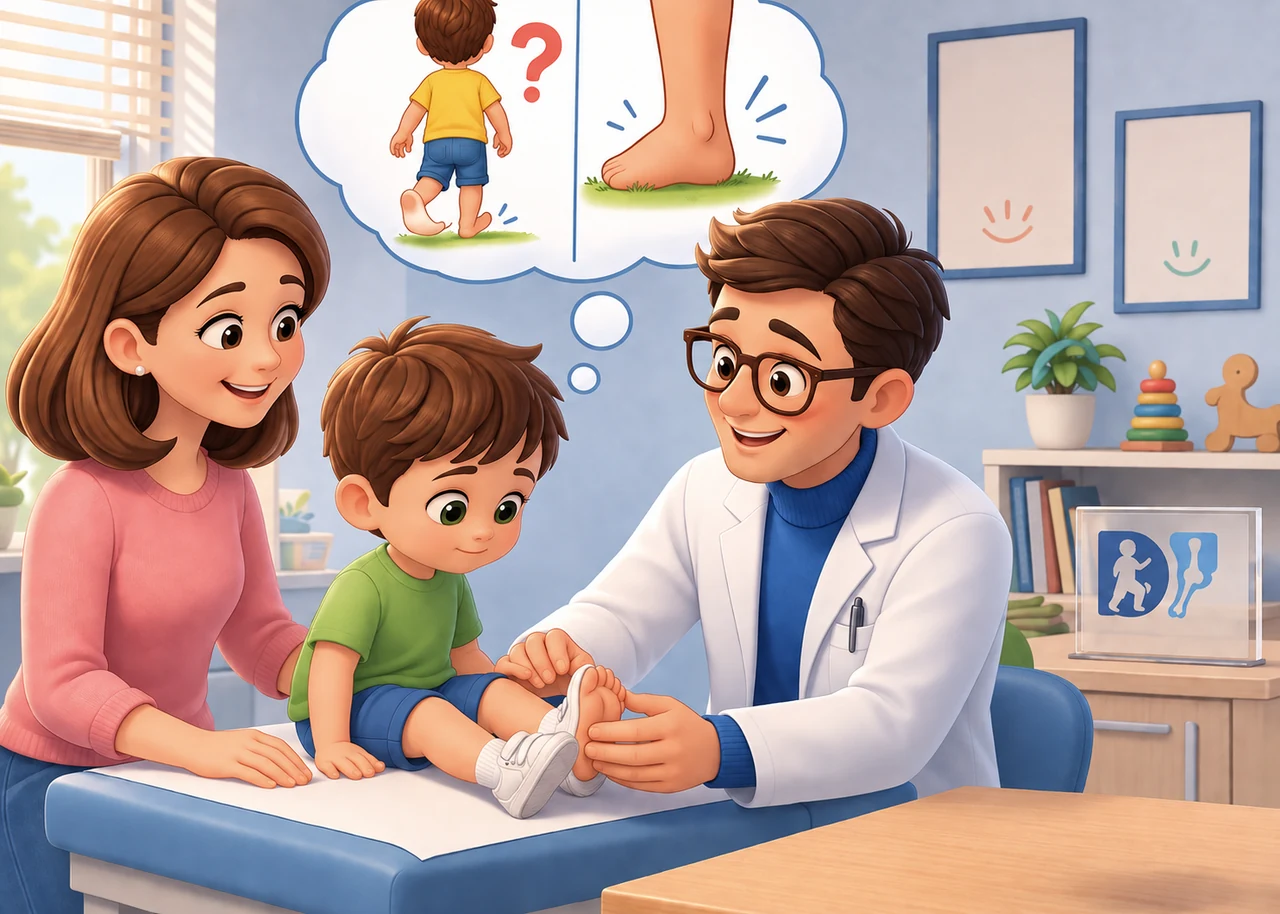
A child starts limping. The X-ray is normal. It is easy to assume that the problem is settled, or to go to the other extreme and worry that the scan has “missed something”.
An X-ray is only one part of the assessment. In children, a limp can start in the foot, knee, hip or, less commonly, the back. The place where a child feels pain is not always where the problem begins. A hip problem, for example, may cause knee pain. [1][3]
Even a correctly performed X-ray can be normal in the early stages of some conditions. A subtle toddler’s fracture may not be visible straight away, while transient synovitis does not necessarily cause changes in the bones on an X-ray. In the early stages of a bone or joint infection, the X-ray may also still look normal. [1][2][4]
This does not mean that every child with a limp and a normal X-ray needs further tests. Many children have a minor injury, transient synovitis or another condition that settles on its own and improves over time. The Royal Children’s Hospital guidelines make this point: not every child who limps needs an extensive set of investigations straight away. [2][5]
When a normal X-ray is reasonably reassuring
What matters most is how the child is feeling and how the situation develops.
If the child can still walk, has no fever, has moderate pain that is not getting worse, and the examination is consistent with a minor injury or a benign condition, it is often reasonable to monitor progress and reassess if the limp persists. [1][2][3]
Age helps guide the assessment. In young children, a toddler’s fracture can follow an apparently minor injury, or one that the parents barely remember. In one paediatric study, initial imaging was normal in about a quarter of the children who were later given this diagnosis. [4]
In other cases, the cause may be transient synovitis of the hip, particularly if the child is otherwise well and has no high fever or significant signs of general illness. [2][5]
Signs that need closer attention
A sudden inability to walk or bear weight is a red flag. So are fever, rapid deterioration, significant night pain, feeling generally unwell, joint swelling or a marked restriction of movement. A limp that continues without a convincing explanation also needs reassessment. [1][2][3]
The combination of fever, refusal to bear weight and restricted joint movement needs particular attention because septic arthritis is one of the conditions that must be excluded. A normal X-ray does not rule it out. [1][2]
In older children, other conditions also enter the differential diagnosis: Perthes disease, bone or joint infections, foot or knee problems, inflammatory conditions and, much more rarely, tumours. The history, location of the pain, changes over time and physical examination guide decisions about whether further investigations are needed and which ones to choose. [3]
Sometimes the child simply needs to be examined again
The course of the condition can provide information that was not available at the first appointment. Pain that quickly improves and a limp that disappears are different from a child who still cannot bear weight after several days or keeps pointing to the same painful spot.
When the initial findings are reassuring, reassessment may therefore be more useful than an immediate series of tests without a clear question to answer. If red flags appear, however, a normal first X-ray must not delay further investigation.
A normal X-ray is useful information, but it needs to be considered alongside the examination and the way the child’s symptoms develop. [1][2][3]
References
[1] Truong T, Chang D, Friedman S. Limping Child. Pediatrics in Review. 2024;45(8):476-478. doi:10.1542/pir.2023-006052. PMID: 39085187.
PubMed: https://pubmed.ncbi.nlm.nih.gov/39085187/
[2] Royal Children’s Hospital Melbourne. Clinical Practice Guidelines: The limping or non-weight bearing child.
Webpage: https://www.rch.org.au/clinicalguide/guideline_index/Child_with_limp/
[3] Morancie NA, Helton MR. Evaluating the Child With a Limp. American Family Physician. 2023;107(5):474-485. PMID: 37192073.
PubMed: https://pubmed.ncbi.nlm.nih.gov/37192073/
[4] Pujol M, et al. Current diagnosis and management of toddler’s fracture. An Pediatr (Barc). 2019;91(3):e1-e7. PMID: 31311775.
PubMed: https://pubmed.ncbi.nlm.nih.gov/31311775/
[5] Asche SS, van Rijn RM, Bessems JHJM, Krul M, Bierma-Zeinstra SMA. What is the clinical course of transient synovitis in children: a systematic review of the literature. Chiropr Man Therap. 2013;21:39. PMID: 24229447.
PubMed: https://pubmed.ncbi.nlm.nih.gov/24229447/
Disclaimer: This content is for general information and does not replace an individual medical assessment.