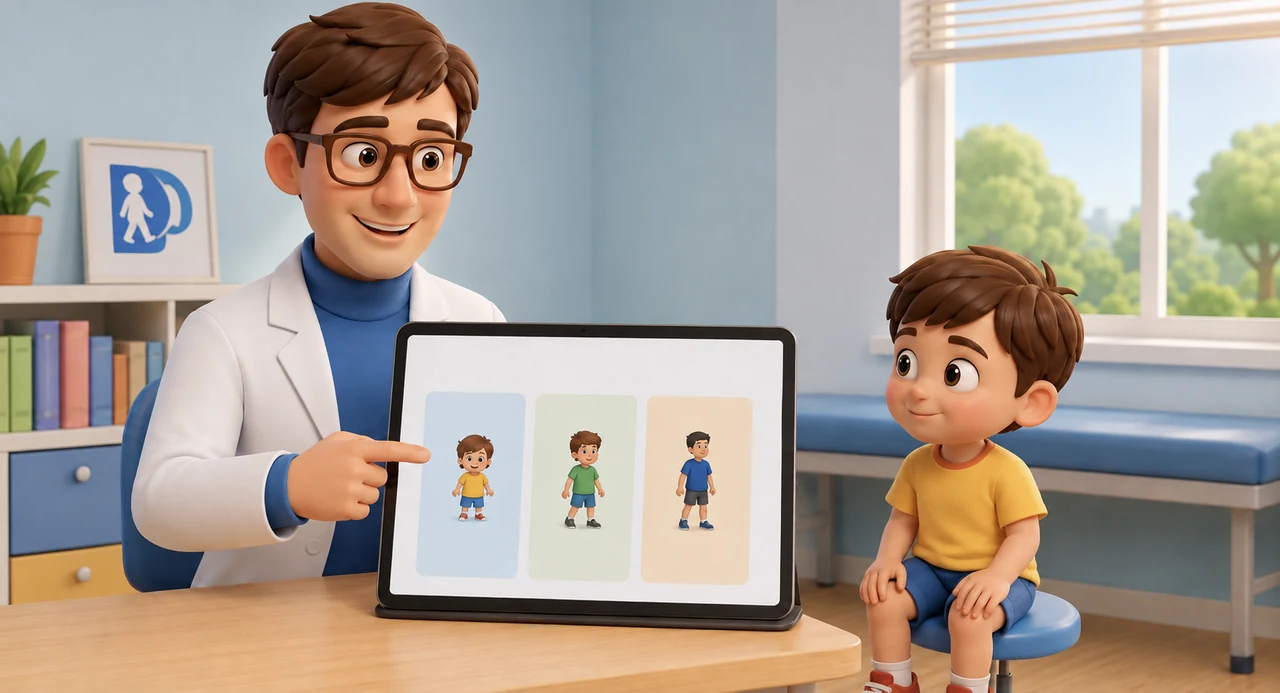
A sudden limp can be due to a minor injury, but age significantly changes the diagnoses to consider. A 2-year-old child who refuses to bear weight has a different profile than an 8-year-old child or a sporty teenager. [1,2]
Limping is a clinical sign, not a diagnosis. The ability to bear weight, fever, location and intensity of pain, duration of symptoms, and joint mobility are particularly important for guidance.
Can the child bear weight?
The first practical distinction is between a child who limps but walks and a child who cannot bear weight on the limb at all.
Acute inability to walk or bear weight is considered a red flag in pediatric guidelines [1]. This does not automatically mean there is a serious condition, but it is an element that deserves attention, especially if associated with fever, significant pain, limited movement, or rapid worsening.
Conversely, a mild limp in a child in good general condition, without fever, and improving, may have a different meaning. Even in this case, however, the evolution matters: a limp that does not improve or recurs multiple times should be re-evaluated.
From 0 to 4 years: often the child cannot say where it hurts
In young children, evaluation can be more difficult. The child cannot always precisely indicate the location of the pain. Sometimes they say "my knee hurts," but the problem might be in the hip; other times they indicate nothing and simply refuse to walk.
In this age group, causes to consider include minor traumas, initially subtle fractures, transient synovitis of the hip, osteoarticular infections, and, more rarely, non-strictly orthopedic conditions that alter gait [1,2].
A typical situation in young children is the so-called toddler fracture, a non-displaced fracture of the tibia that can occur even after an apparently minor trauma. In some cases, the first X-ray may not be very clear, especially in the initial stages [2].
In young children, attention must also be paid to osteoarticular infections. Fever, marked irritability, refusal to bear weight, pain on joint mobilization, or rapid worsening are elements that require timely evaluation [1].
From 5 to 10 years: hip, Perthes, infections, and inflammatory conditions
Between 5 and 10 years of age, a common cause of acute limping is transient synovitis of the hip, often following a viral episode. It is generally a benign condition, but in clinical practice, it must be distinguished from more serious conditions, particularly septic arthritis [1,3].
In this age group, Perthes disease should also be remembered, which can present with limping and pain not always clearly localized to the hip. Some children report pain in the thigh or knee. For this reason, when a child limps, the hip should be evaluated even if the pain seems more distant [1,2].
Other possibilities include trauma, fractures, osteomyelitis, discitis, and inflammatory or rheumatological conditions. Morning stiffness, joint swelling, general symptoms, or persistent pain suggest a broader evaluation [1,2].
Over 10 years: do not forget slipped capital femoral epiphysis
In adolescents, limping requires a different line of reasoning. A diagnosis not to be forgotten is slipped capital femoral epiphysis, also known as SCFE or SUFE [1,2].
It can manifest with hip pain, but also with thigh or knee pain. This is an important point: in an adolescent with knee pain and limping, one should not only look at the knee. The hip must also be evaluated.
In this age group, sports-related and overuse causes are also common, such as traction apophysitis, stress fractures, sprains, patellar instability, or meniscal problems. More rarely, progressive pain, nocturnal pain, or general symptoms may require investigations to rule out more serious conditions [1,2].
Warning signs to watch for
Not all limps require the same degree of urgency. Some elements, however, should raise the level of attention.
It is advisable to have the child evaluated quickly if:
- they cannot bear weight on the limb;
- they have a fever;
- they appear very unwell, lethargic, or irritable;
- they have intense pain;
- they have a swollen, warm, or very painful joint;
- they have marked limitation of movement;
- they have persistent nocturnal pain;
- the limp worsens or does not improve;
- there is pallor, significant fatigue, weight loss, or other general symptoms;
- the pain is referred to the knee, but hip movement seems limited [1,2].
These elements are not for making a diagnosis, but for understanding that the situation warrants a more careful clinical evaluation.
Transient synovitis or septic arthritis?
One of the most delicate steps in acute limping in children is distinguishing between transient synovitis of the hip and septic arthritis.
Transient synovitis is relatively common and often resolves without consequences. Septic arthritis, however, is an orthopedic emergency, because a joint infection that is not treated promptly can damage the joint [1,3,4].
To aid this distinction, Kocher's criteria were described, later modified by Caird. The elements considered include fever, refusal to bear weight, increased ESR, increased white blood cell count, and elevated CRP [3,4].
However, these criteria should not be used as an autonomous "diagnostic calculator." They are tools to support clinical reasoning and must be interpreted together with the examination, tests, the child's age, and the evolution of symptoms [3-5].
A recent meta-analysis confirmed the role of fever, refusal to bear weight, ESR, and white blood cells in distinguishing between septic arthritis and transient synovitis, but emphasized that clinical decision-making must remain cautious and contextualized [5].
A normal X-ray does not always close the issue
X-rays are often useful, especially if there has been trauma, if the pain is localized, or if fractures, Perthes, slipped capital femoral epiphysis, or other bone pathologies are suspected.
However, a normal X-ray does not always rule out all causes of limping. Some non-displaced fractures, early infections, stress fractures, or very early stages may not be immediately evident [1,2].
For this reason, when symptoms persist, worsen, or are not consistent with the initial suspicion, it may be necessary to re-evaluate the child and choose further investigations based on the clinical picture.
When a faster evaluation is needed
A child who limps but is otherwise well, has no fever, and improves quickly may have a transient cause. Refusal to bear weight, fever, significant pain, worsening, or the appearance of general symptoms, however, require a more timely evaluation. [1,2]
The reported location should also be interpreted with caution: a hip problem can present as knee pain, especially in older children.
References
[1] Royal Children’s Hospital Melbourne. Clinical Practice Guidelines: The limping or non-weight bearing child. Last updated: October 2025.
Link: RCH Clinical Guideline
[2] Sawyer JR, Kapoor M. The limping child: a systematic approach to diagnosis. American Family Physician. 2009;79(3):215-224.
PubMed: PMID 19202969
[3] Kocher MS, Zurakowski D, Kasser JR. Differentiating between septic arthritis and transient synovitis of the hip in children: an evidence-based clinical prediction algorithm. Journal of Bone and Joint Surgery American Volume. 1999;81(12):1662-1670.
DOI: 10.2106/00004623-199912000-00002
[4] Caird MS, Flynn JM, Leung YL, Millman JE, D’Italia JG, Dormans JP. Factors distinguishing septic arthritis from transient synovitis of the hip in children. A prospective study. Journal of Bone and Joint Surgery American Volume. 2006;88(6):1251-1257.
DOI: 10.2106/JBJS.E.00216
[5] QingSong T, XinLing M, Xiang R, et al. Clinical indicators for distinguishing septic arthritis from paediatric transient synovitis of the hip: a systematic review and meta-analysis. BMC Infectious Diseases. 2024;24:1432.
DOI: 10.1186/s12879-024-10341-z
Disclaimer: content for general informational purposes only. It does not replace a medical evaluation.