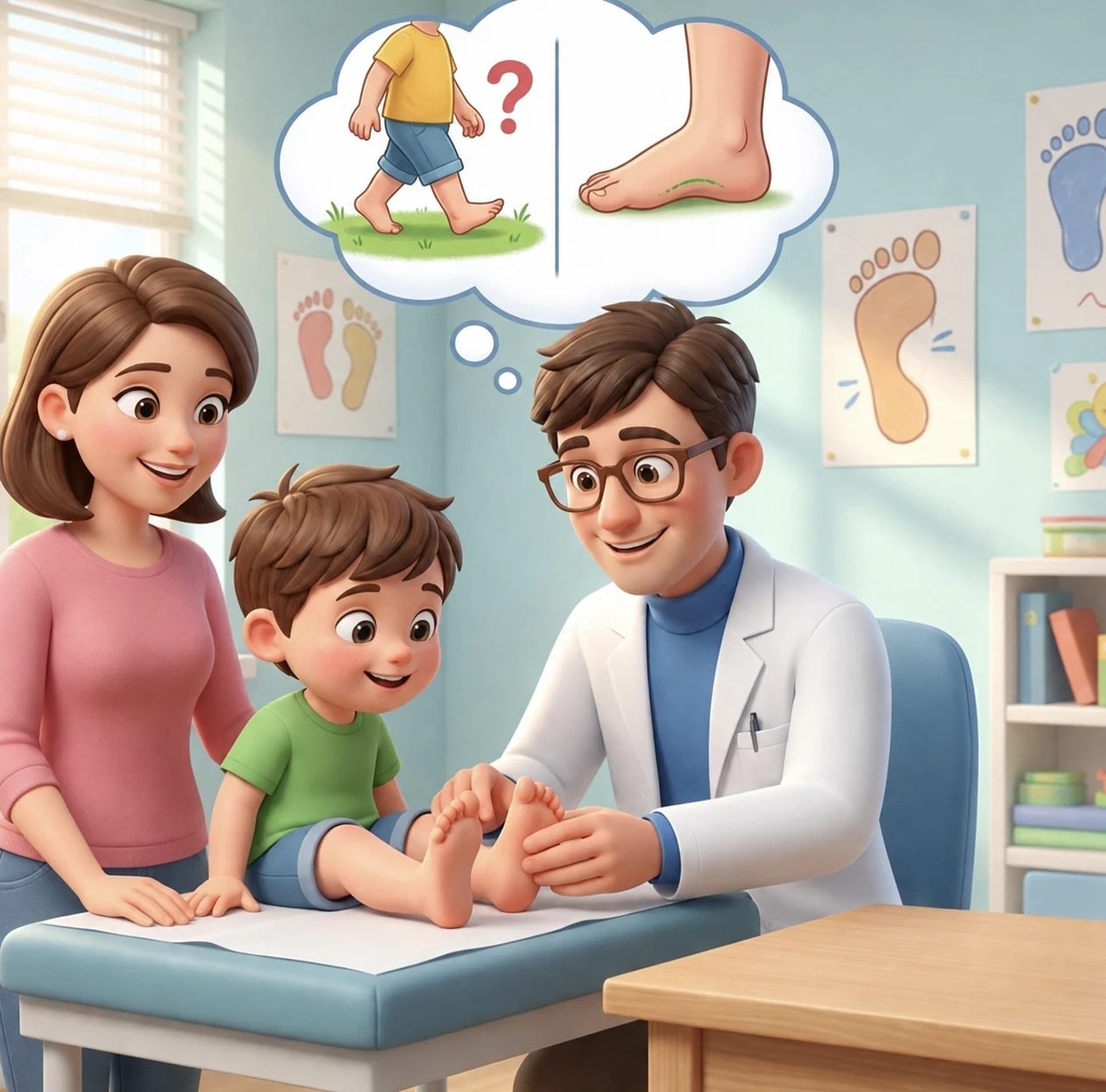
Walking barefoot and walking with shoes are not biomechanically equivalent. They change foot contact, plantar pressures, and some gait parameters. This, however, does not prove that barefoot walking creates or corrects the arch of the foot. [1–3]
In the early years, an apparently flat foot is very common. The prevalence decreases with growth, and many children show a visible arch when they stand on their toes or when the foot is not bearing weight: this is the typical flexible flat foot. [1]
What We Know About Barefoot Walking
Some observational studies have found a lower prevalence of flat foot in populations that walk barefoot more often. [1]
However, these comparisons do not allow us to separate the role of footwear, physical activity, body weight, environment, and cultural habits. Therefore, we do not have sufficient evidence to prescribe barefoot walking as a treatment for flat feet.
If a child enjoys being barefoot at home or on safe surfaces, there is no reason to prevent it. The main benefit is freedom of movement, not the promise of creating an arch.
Which Shoes to Choose
The characteristics of a shoe influence the way of walking, but the literature does not identify a universal model capable of improving arch development. [2][3]
For a healthy child, the most important factors are correct size, toe space, comfort, sufficient flexibility, and suitability for the activity. A rigid or "orthopedic" shoe is not necessary to shape a foot that has no symptoms.
When a Flat Foot Warrants Evaluation
Recurrent pain, fatigue that limits walking or sports, stiffness, marked asymmetry, limping, significant tightness of the gastrocnemius-Achilles complex, or a rapidly worsening deformity require a more precise assessment.
A flexible, bilateral, and painless foot in a child who runs and plays normally has a very different meaning.
The Role of Orthotics
In asymptomatic flexible flat feet, I do not prescribe orthotics solely to make the arch more evident.
In symptomatic children, however, orthotics can reduce pain and modify some biomechanical or radiographic parameters. A recent meta-analysis, however, does not demonstrate that they permanently build a normal arch. [4]
Treatment should therefore be guided by symptoms and function, not by the appearance of the foot taken in isolation.
References
[1] Chen KC, Tung LC, Tung CH, Yeh CJ, Yang JF, Wang CH. Risk Factors of Flatfoot in Children: A Systematic Review and Meta-Analysis. Int J Environ Res Public Health. 2022;19(14):8247. PMID: 35886097.
[2] Xu D, Quan W, Zhou H, Sun D, Baker JS, Gu Y. Understanding the Role of Children's Footwear on Children's Feet and Gait Development: A Systematic Scoping Review. Healthcare (Basel). 2023;11(10):1418. doi:10.3390/healthcare11101418. PMID: 37239704.
[3] Cranage S, Perraton L, Bowles KA, Williams C. The impact of shoe flexibility on gait, pressure and muscle activity of young children. A systematic review. J Foot Ankle Res. 2019;12:55. doi:10.1186/s13047-019-0365-7. PMID: 31798689.
[4] Liu C, Zhang H, Li J, et al. The effects of foot orthoses on radiological parameters and pain in children with flexible flat feet: a systematic review and meta-analysis. Front Pediatr. 2024;12:1388248. doi:10.3389/fped.2024.1388248. PMID: 39156020.
Disclaimer: This content is for informational purposes only and does not replace an individual clinical evaluation.