Osgood-Schlatter: Knee Pain in Young Athletes
Pain below the knee after sports: Osgood-Schlatter disease is the most common cause in adolescents and needs proper assessment to guide treatment.
Quick Answers
How long does Osgood-Schlatter last?
Does my child need to stop sports?
One area, different causes
Pain at the front of the knee is not a single diagnosis. Location, activity and examination help distinguish the causes.
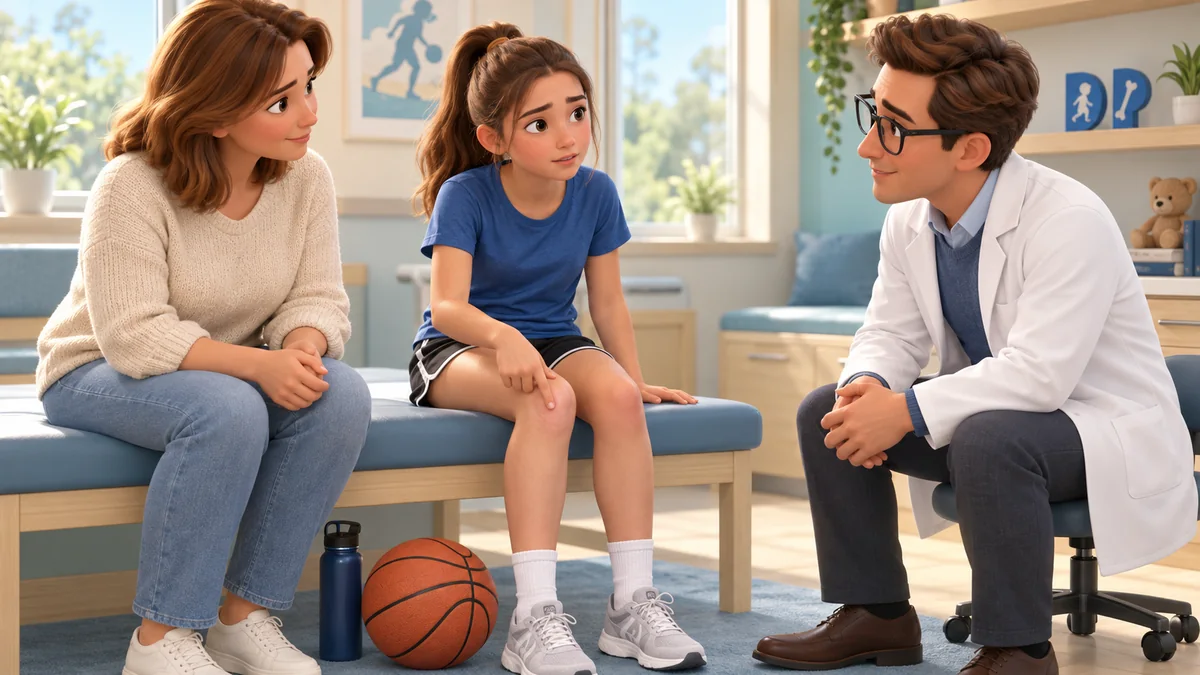
Read all the illustrated explanations →Picture this: your 12-year-old comes home from soccer practice, limping and pointing to a hard, painful bump just below the knee. You press it and he winces. This is the classic presentation of Osgood-Schlatter disease.
It's the most common cause of knee pain in adolescents aged 10 to 15, particularly those involved in sports with running, jumping, and quick direction changes — soccer, basketball, volleyball, track and field. The mechanism is straightforward: the patellar tendon repeatedly pulls on the growth plate of the tibial tuberosity (that bony bump you feel below the kneecap), causing local inflammation.
The reassuring news? Osgood-Schlatter always resolves on its own, because it disappears when the growth plate closes — typically between ages 14-16 in boys and 12-14 in girls. The catch is that the course is long — we're talking months, sometimes a year or more — and the pain follows a wave-like pattern: worse during intense training periods, better with relative rest.
The key is load management: in most cases, there's no need to stop sports entirely. Instead, we reduce intensity, avoid the most provocative movements (jumping, uphill sprints), and follow a stretching and strengthening program. Complete rest is only warranted when pain persists at rest or causes limping.
Assessment and treatment
When to seek evaluation
- Pain localized below the kneecap (tibial tuberosity)
- Pain worsening with running, jumping or climbing stairs
- Swelling or bony prominence below the knee
- Pain after intense sports activity
- Limping during or after sports
- Bilateral pain (both knees)
What is evaluated
- Palpation of the tibial tuberosity
- Pain assessment with resisted quadriceps contraction
- Muscle flexibility testing (quadriceps, hamstrings, gastrocnemius)
- Lower limb alignment examination
- X-ray in selected cases (to rule out other causes or fragment avulsion)
Treatment options
- Activity modification (reduction, not complete cessation)
- Specific quadriceps and hamstring stretching
- Progressive eccentric strengthening
- Ice application after activity (15 min)
- Infrapatellar strap in symptomatic cases
- Gradual return to full sports with progressive protocol
Frequently Asked Questions
How long does Osgood-Schlatter last?▼
Does my child need to stop sports?▼
Does Osgood-Schlatter leave permanent effects?▼
How is it diagnosed?▼
Does ice really help?▼
Can Osgood-Schlatter affect both knees?▼
What is the difference between Osgood-Schlatter and Sinding-Larsen-Johansson?▼
Other Juvenile Osteochondroses
Osteochondroses are a family of growth-related conditions. Learn about the others:
Important Notice: The information on this page is for educational and informational purposes only and does not constitute medical advice. Each clinical case is unique: the appropriate treatment is determined during the specialist consultation, based on a thorough clinical examination and, where necessary, diagnostic imaging. For any doubts or concerns, please consult a specialist.